
I had some interesting conversations while at the recent conference in Washington, D.C.. One such conversation, with the Director of Sales for one of my houses, was particularly sobering. He said that they’d just run the numbers on all their New York Times bestselling authors for the year to date, and that the sales of every one of them were down between 15 and 30% compared to last year.
Think about that. James Patterson: off 21%. A big selling romance writer I won’t name since she gave me the figure herself: off 30%. This director of sales says he’s been in the business for 30 years and he has never seen a downturn like this. You know how bookstores will sell something like, say, Dan Brown at 40% off? It’s a “lead loss.” The bookstore takes a loss on the bestseller in order to lure buyers into the store. Normally, readers will buy the lead loss and four or five other books. Now, they’re buying the lead loss and just walking out. Not good.
He does say he’s hopeful things will turn around this fall. But here’s the part that worries me: It seems all the houses have been holding back the books of many of their traditional big sellers, hoping the market will improve later in the year. So there are going to be lots of books by big-name authors coming out this fall. And as my source said, they’re going to cannibalize each other’s sales.
Unfortunately, I have three books coming out this fall—one paperback original, one paperback reprint, and one hardcover original. Not good news. Not good news, at all.
Friday, July 24, 2009


Monday, July 20, 2009
Ever Have One of Those Weeks?
You know the kind I mean. When you’re supposed to be home packing to go to a conference and instead you’re in the hospital? When your publisher sends 200 books for you to give away at a signing and someone steals all five boxes? When you’re rushing to get ready for a couple of important parties and there’s a fire in the hotel that requires everyone to evacuate right away?
Still, I had a great time at RWA’s National Convention in Washington, D.C., last week, even though I spent a big chunk of it lying down in my hotel room resting, as per my doctor’s orders (“You’re not STILL planning on going, are you?”). I had some interesting conversations with heads of publicity and sales (more about that later). I got to catch up with my agent and both my editors. And although I didn’t win the RITA, I met so many ardent fans of my books—both the Sebastian mysteries and my old romances—that I was both amazed and humbled.
So it was worth it. But all I can say is, I’m glad to be home!
Still, I had a great time at RWA’s National Convention in Washington, D.C., last week, even though I spent a big chunk of it lying down in my hotel room resting, as per my doctor’s orders (“You’re not STILL planning on going, are you?”). I had some interesting conversations with heads of publicity and sales (more about that later). I got to catch up with my agent and both my editors. And although I didn’t win the RITA, I met so many ardent fans of my books—both the Sebastian mysteries and my old romances—that I was both amazed and humbled.
So it was worth it. But all I can say is, I’m glad to be home!
Wednesday, July 08, 2009
Just for Laughs
I don’t know about you, but I feel in need of a laugh at the moment. So my thanks to Dave Carroll, who got his own back at United Airlines (I have really, really hated United Airlines ever since my 10-month-old baby almost died on one of their flights, but this is about laughter so we won’t go into that). Anyway, here's Carroll's saga in his own words:
"In the spring of 2008, Sons of Maxwell were traveling to Nebraska for a one-week tour and my Taylor guitar was witnessed being thrown by United Airlines baggage handlers in Chicago. I discovered later that the $3500 guitar was severely damaged. They didn't deny the experience occurred but for nine months the various people I communicated with put the responsibility for dealing with the damage on everyone other than themselves and finally said they would do nothing to compensate me for my loss. So I promised the last person to finally say "no" to compensation (Ms. Irlweg) that I would write and produce three songs about my experience with United Airlines and make videos for each to be viewed online by anyone in the world."
Without further ado, here’s Dave’s revenge:
Go, Dave!
"In the spring of 2008, Sons of Maxwell were traveling to Nebraska for a one-week tour and my Taylor guitar was witnessed being thrown by United Airlines baggage handlers in Chicago. I discovered later that the $3500 guitar was severely damaged. They didn't deny the experience occurred but for nine months the various people I communicated with put the responsibility for dealing with the damage on everyone other than themselves and finally said they would do nothing to compensate me for my loss. So I promised the last person to finally say "no" to compensation (Ms. Irlweg) that I would write and produce three songs about my experience with United Airlines and make videos for each to be viewed online by anyone in the world."
Without further ado, here’s Dave’s revenge:
Go, Dave!
Tuesday, July 07, 2009
Goodbye, Little Sweetheart
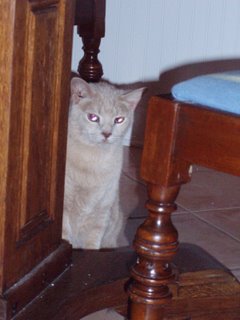
Press Cat, 1999-2009
Losing a cat is always hard. Losing two relatively young cats within months of each other is…hell.
We always knew Press would never live to be an old cat. He started life as a feral waif who wandered into Steve’s factory and took up residence beneath the company’s giant press (hence his name). When Steve trapped him, he was so covered in oil and dirt that Steve thought he was a gray tabby. Petroleum and cats, needless to say, are not a good mix.
He spent the next four years of life running wild in Steve’s bachelor pad with the tuxedo cat twins, Nick and Nora. When we married, it took Steve five hours and several nasty bites and scratches to stuff Press in a carrier so the gang could move over to my house. In the nearly six years since then—wooed nightly with his favorite, tuna—he calmed down a lot. Every night when I’d lay down on the sofa to watch the Daily Show and Colbert, I’d trail my hand over the side and Press would come on the run. As long as he was sure I wasn’t in a position to grab him, he’d let me pet him until my arm (or leg—he also loved foot pets while I was at the computer) felt like it was ready to drop off. He’d purr and purr and purr. But try to reach for him and he was gone.
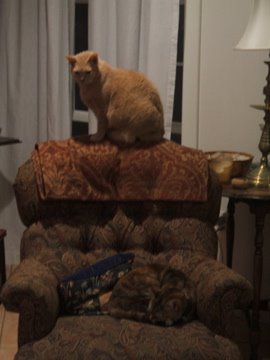
Because he was impossible to catch, he rode out Katrina in our house and lived in the flooded shambles for a week before we battled our way back in to rescue him. (Needless to say, he went with us for Gustav.) About five years ago he had a bout of ill health when the vet told us his kidneys were failing and he’d probably only live a few more months. So we always knew that each passing year was a gift.
He went down hill very suddenly. When he sniffed at Sunday night’s tuna and turned away, I knew something was wrong. Our vet told us just how wrong. Having just watched Nick take months to die of kidney failure, we’d already made up our minds we weren’t putting another cat through that.
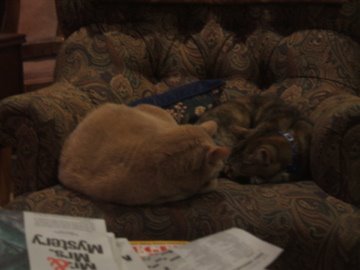
But God, it hurts.
Thursday, July 02, 2009
The Dunning-Kruger Effect
**
It’s one of those phenomena we’ve all encountered—and puzzled over—time and time again. There's the incompetent but amazingly smug coworker whose misplaced self-confidence perversely convinces his manager the idiot is a superstar, thus earning the fraud an undeserved promotion. Then there’s the appallingly ignorant but blazingly self-confident politician who speaks with such poise and self-assurance that a huge chunk of her audience doesn’t notice she’s spouting an incomprehensible tangle of meaningless words and phrases. So it’s nice to know that scientists have actually calibrated, explained, and named this marvel: it’s called the Dunning-Kruger Effect.
So what is the Dunning-Kruger Effect? Basically, it’s the tendency of people who are incompetent to over-estimate their own competency. Or, in Dunning and Kruger’s words, “ignorance more frequently begets confidence than knowledge.”
According to their Nobel Prize winning study Unskilled and Unaware of It: How Difficulties in Recognizing One’s Own Incompetence Lead to Inflated Self-Assessments (http://www.apa.org/journals/features/psp7761121.pdf), the most incompetent people are exactly the ones most convinced of their competence. “The skills that engender competence in a particular domain are often the very same skills necessary to evaluate competence in that domain—one's own or anyone else's. Because of this, incompetent individuals lack what cognitive psychologists variously term metacognition….
“In a perfect world, everyone could see the judgments and decisions that other people reach, accurately assess how competent those decisions are, and then revise their view of their own competence by comparison. However, [our studies] showed that incompetent individuals are unable to take full advantage of such opportunities. Compared with their more expert peers, they were less able to spot competence when they saw it, and as a consequence, were less able to learn that their ability estimates were incorrect…Incompetence, like anosognosia, not only causes poor performance but also the inability to recognize that one's performance is poor.”
An interesting corollary is that the most competent people usually underestimate their competence. In other words, the more you know, the more you focus on what you don’t know. And, ironically, the more inclined you are to believe that your peers know as much if not more than what you do.
Of course, none of this is news. It was Thomas Jefferson who once said, "he who knows best best knows how little he knows," while Charles Darwin observed back in 1871 that "ignorance more frequently begets confidence than does knowledge." And then there’s the British philosopher Bertrand Russell (who, ironically, never suffered much from self-doubt) who said, “the trouble with the world is that the stupid are cocksure and the intelligent are full of doubt.”
It’s one of those phenomena we’ve all encountered—and puzzled over—time and time again. There's the incompetent but amazingly smug coworker whose misplaced self-confidence perversely convinces his manager the idiot is a superstar, thus earning the fraud an undeserved promotion. Then there’s the appallingly ignorant but blazingly self-confident politician who speaks with such poise and self-assurance that a huge chunk of her audience doesn’t notice she’s spouting an incomprehensible tangle of meaningless words and phrases. So it’s nice to know that scientists have actually calibrated, explained, and named this marvel: it’s called the Dunning-Kruger Effect.
So what is the Dunning-Kruger Effect? Basically, it’s the tendency of people who are incompetent to over-estimate their own competency. Or, in Dunning and Kruger’s words, “ignorance more frequently begets confidence than knowledge.”
According to their Nobel Prize winning study Unskilled and Unaware of It: How Difficulties in Recognizing One’s Own Incompetence Lead to Inflated Self-Assessments (http://www.apa.org/journals/features/psp7761121.pdf), the most incompetent people are exactly the ones most convinced of their competence. “The skills that engender competence in a particular domain are often the very same skills necessary to evaluate competence in that domain—one's own or anyone else's. Because of this, incompetent individuals lack what cognitive psychologists variously term metacognition….
“In a perfect world, everyone could see the judgments and decisions that other people reach, accurately assess how competent those decisions are, and then revise their view of their own competence by comparison. However, [our studies] showed that incompetent individuals are unable to take full advantage of such opportunities. Compared with their more expert peers, they were less able to spot competence when they saw it, and as a consequence, were less able to learn that their ability estimates were incorrect…Incompetence, like anosognosia, not only causes poor performance but also the inability to recognize that one's performance is poor.”
An interesting corollary is that the most competent people usually underestimate their competence. In other words, the more you know, the more you focus on what you don’t know. And, ironically, the more inclined you are to believe that your peers know as much if not more than what you do.
Of course, none of this is news. It was Thomas Jefferson who once said, "he who knows best best knows how little he knows," while Charles Darwin observed back in 1871 that "ignorance more frequently begets confidence than does knowledge." And then there’s the British philosopher Bertrand Russell (who, ironically, never suffered much from self-doubt) who said, “the trouble with the world is that the stupid are cocksure and the intelligent are full of doubt.”
Subscribe to:
Posts (Atom)


