
Showing posts with label people. Show all posts

Tuesday, January 12, 2010

An Inspiration to Us All


This is the story of a remarkable person.

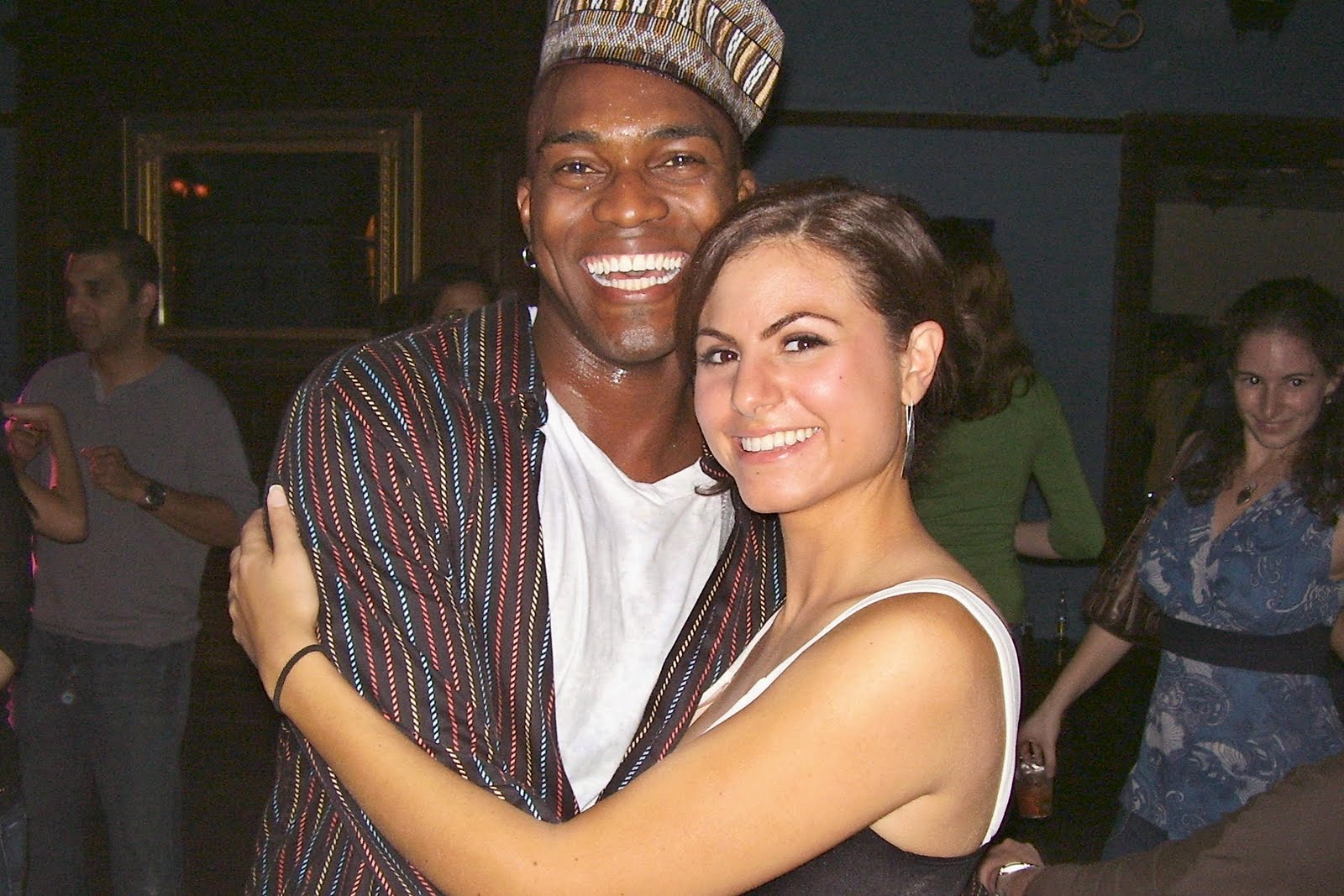
My daughter’s best friend at Yale Law School was a guy named Seun Adebiyi. Seun (pronounced so that it sounds pretty much like “Sean”) was born in Nigeria, but came to the States as a child. A competitive swimmer, he represented Nigeria in international competitions for years and only just missed qualifying for the 2004 Olympic summer games by a fraction of a second (although he doesn’t say why on his blog, it’s because he was still recovering from something nasty, like a broken back). He’s one of those people with boundless energy and endless talents. He has a pilot’s license. He is a certified massage therapists who likes nothing better than giving his friends massages. He sky dives (okay, I’ll admit I’d have been happier if he hadn’t introduced my daughter to that particular passion). He campaigned hard for Barack Obama. He is inspiringly dedicated to his yoga and meditation practices.

**

After graduating from Yale Law, he took a job on Wall Street, started training to swim the English Channel, and embarked on a new ambition: to make history as the first Nigerian delegate to compete in the Winter Olympics. His sport: the skeleton. As Seun describes it, “First imagine the luge. Now flip over onto your stomach, and put your hands by your side. With no brakes and minimal steering, you careen precipitously down a bobsled track at nearly 80 mph. Headfirst.”


And then, out of nowhere, came the unbelievable, heart-stopping news: Seun discovered he has both stem cell leukemia and lymphoblastic lymphoma. His only hope for survival is to find a donor for a bone marrow transplant. But here’s the problem: very, very few African-Americans are enrolled in the national bone marrow registry. As a result, 83% of African-American patients like Seun never receive a transplant. Seun’s situation is made worse by the fact that he isn’t your typical African-American: he’s 100% Nigerian.

Of course, with a guy like Seun, what comes next isn’t much of a surprise. Seun has launched a massive drive to recruit 10,000 new potential donors to the national registry, with a special emphasis on encouraging African-American donors. All it takes to register is a cheek swab. Of course, if you’re found to be a match, you need to be committed to the donation process, which can be done in one of two ways. Both are outpatient procedures and neither is especially grueling. You can learn more about becoming a donor or register online at skmsamericas.org.

To learn more about Seun, watch his video…

**

See the support he's receiving from people like Justin Chambers and Rihanna here. You can also read his article at the Huffington Post, and follow his inspiring story on his blog, Seun's Skeleton Blog.

And please, consider signing up for the national Marrow Donor Program. As Seun says, “in 2014, when I am racing down the Olympic slopes in Sochi, Russia, you can say you helped me make it to the finish line.”

**

Thursday, July 02, 2009

The Dunning-Kruger Effect

**

It’s one of those phenomena we’ve all encountered—and puzzled over—time and time again. There's the incompetent but amazingly smug coworker whose misplaced self-confidence perversely convinces his manager the idiot is a superstar, thus earning the fraud an undeserved promotion. Then there’s the appallingly ignorant but blazingly self-confident politician who speaks with such poise and self-assurance that a huge chunk of her audience doesn’t notice she’s spouting an incomprehensible tangle of meaningless words and phrases. So it’s nice to know that scientists have actually calibrated, explained, and named this marvel: it’s called the Dunning-Kruger Effect.

So what is the Dunning-Kruger Effect? Basically, it’s the tendency of people who are incompetent to over-estimate their own competency. Or, in Dunning and Kruger’s words, “ignorance more frequently begets confidence than knowledge.”

According to their Nobel Prize winning study Unskilled and Unaware of It: How Difficulties in Recognizing One’s Own Incompetence Lead to Inflated Self-Assessments (http://www.apa.org/journals/features/psp7761121.pdf), the most incompetent people are exactly the ones most convinced of their competence. “The skills that engender competence in a particular domain are often the very same skills necessary to evaluate competence in that domain—one's own or anyone else's. Because of this, incompetent individuals lack what cognitive psychologists variously term metacognition….

“In a perfect world, everyone could see the judgments and decisions that other people reach, accurately assess how competent those decisions are, and then revise their view of their own competence by comparison. However, [our studies] showed that incompetent individuals are unable to take full advantage of such opportunities. Compared with their more expert peers, they were less able to spot competence when they saw it, and as a consequence, were less able to learn that their ability estimates were incorrect…Incompetence, like anosognosia, not only causes poor performance but also the inability to recognize that one's performance is poor.”

An interesting corollary is that the most competent people usually underestimate their competence. In other words, the more you know, the more you focus on what you don’t know. And, ironically, the more inclined you are to believe that your peers know as much if not more than what you do.

Of course, none of this is news. It was Thomas Jefferson who once said, "he who knows best best knows how little he knows," while Charles Darwin observed back in 1871 that "ignorance more frequently begets confidence than does knowledge." And then there’s the British philosopher Bertrand Russell (who, ironically, never suffered much from self-doubt) who said, “the trouble with the world is that the stupid are cocksure and the intelligent are full of doubt.”

Tuesday, July 11, 2006

The Problem with Anarchy


I’m not a person who loves cops. Don’t get me wrong: one of my favorite cousins spent 30 years on the New Orleans police force, and a friend of mine was a cop for many years. So I know some cops are good, compassionate people. Unfortunately, other cops are not. Power can bring out the worst in people, and some cops are insufferable assholes on power trips with the ethical standards of a mob hit man. Which is a bad combination with a badge and a gun.

Why, you might ask, is she writing about cops? Because I’m tired of the lack of cops on our streets. Just as power brings out the worst in some cops, I have come to realize that a lack of cops brings out the worst in some drivers. And they seem to be degenerating as the months go by. Blatantly running red lights and stop signs. Going 20-30 miles over the speed limit in residential neighborhoods. Tailgating. Yes, some of these drivers are lost in a post-Katrina, stress-induced fog. But most are just louts.

It would be nice to think that people can police themselves. Nice to think that even when no one’s watching, people still do the right thing. Some do. Some don’t. Hand a bunch of GIs guns and turn them loose in Iraq, and some will rape and murder and steal when no one is watching. Turn a bunch of New Orleans drivers loose on the streets with no cops, and they start killing people, too—with their cars. Which I suppose is why anarchism is attractive as a political theory, but deadly in practice.

End of rant.

What I’m reading… BUDDHA, by Karen Armstrong. I enjoyed her book on Islam so much, I decided to give this one a try. It’s even better.

Wednesday, May 31, 2006

On FEMA Trailers, Blue Tarps, and Roofs in Trees


I am really tired of seeing big white shiny metal objects cluttering the landscape. I look up and down my street and see shiny white FEMA trailers jutting out of yards, white pickup trucks with Texas plates lining the curbs, and white PODS filling almost everyone’s driveway (if you don’t know what PODS are, they’re Portable On Demand Storage units).

We all seem to have our own private points of annoyance. Danielle is tired of seeing sludge-filled swimming pools and this piece of someone’s roof that’s stuck in an oak tree on Carrolton. Every time we drive past it, she says, “When are they going to get that roof out of that tree?” My mother is tired of the piles of trash that fill the yards of recently gutted houses. Steve is tired of replacing the cracked windshield on his SUV (twice this month). Sam is tired of roofs with flapping blue tarps and tumbled-down chimneys.

Nine months now. One would think we’d be getting used to it all. Instead, our patience is wearing thin. We want normal again. We want Walmarts that are open 24 hours instead of closing at 8:00. We want to be able to order a new mattress and not be told, “Well, the mattress will be here in a week, but the first delivery slot I have open is at the end of next month.” We want to be able to drive across town without having to choke back unshed tears. We want our house, our city, and our lives back.

When it gets really hard to bear, I remind myself of what it was like last October and November, when Walmart closed at 3:30 pm, when we bought a new refrigerator and were told, “It’s cash and carry. You take it with you now, or you can’t buy it.” (We shoved it in the back of Steve’s SUV) Last September, a drive across town took you past piles of ski jets and boats and coffins.

Yes, it is getting better. Just not fast enough.

Sunday, May 28, 2006

Defining Home


We took a few hours off from laying floors this weekend to attend the Destrehan Plantation Spring Festival. We went because it was a good excuse to spend a few hours in the shade of centuries-old oaks, listen to good music, eat good food, and wander around the antique and craft booths. But we also went because we wanted to help support one of my favorite plantations. Without the millions of tourists who used to visit New Orleans every year, the plantations of southern Louisiana are hurting. Actually, a lot of businesses down here are hurting. One tour company has already gone broke; many small shops in the French Quarter will soon follow.

Of the tens of thousands of businesses that once operated in Orleans, Jefferson, and St. Bernard Parishes, only a few thousand have managed to reopen. Many of those still in business are hurting. At first they couldn’t get in stock because FEMA had commandeered all the trucks in the area. They’re still finding it almost impossible to find workers. Many companies that do business on a national or international level are moving out of the area, complaining that there aren’t enough flights in and out of the airport, that investors are leery of investing in a company headquartered in such a vulnerable city, that they can’t get insurance. Our local governments keep talking about the many new business licenses they’re issuing; unfortunately, most of those licenses are for roofing and construction crews from Kansas and Texas, Tennessee and Kentucky—folks who’ll go home when the building boom ends.

New Orleans has always exercised a strong hold on its children; pre-K, the city boasted the highest native-born population in the country. Traditionally, very, very few people who are born and raised here ever move away. Yet I keep hearing about people who are leaving. Sam has a friend named Alice whose family used to live in Slidell. Sam spent many anxious hours with Alice on the night of August 29th, when Alice’s brother and father were stranded on the roof of their house with water up to the eaves and still rising. After the water went down, Alice’s family got a FEMA trailer and went home to rebuild. Except I heard the other day that they’d finally had enough; they’ve sold their half-renovated house and moved to Baton Rouge.

Even within my own family, many are leaving. We lost a total of eight houses in my immediate family—I don’t mean simply damaged, I mean destroyed, totaled, plowed under. One cousin has moved to North Carolina, another to a small Louisiana town an hour northwest of here. Once, they couldn’t have imagined living any place else. It bemuses me that they have gone and I’m still here. Perhaps it’s because I knew I was running a risk when I moved here. They were home; they thought they were safe. Now, they no longer feel safe.

My husband, Steve, thinks the tide will eventually turn. There are many, many jobs here that are unfilled, both professional and blue collar. He thinks that with so many people leaving it will create a vacuum, a vacuum new people will move in to fill. Perhaps. And perhaps in time the city will work its magic on them, in turn. They’ll learn to slow down, to dance in the streets and wait in the rain for hours just for the fleeting joy of snagging a great pair of beads. I hope so. This city is too wonderful to be allowed to die.

Wednesday, May 03, 2006

A Miasma of Despair


Do you believe you can “feel” other people’s emotions, like a faint indefinable presence that hangs in the air? Think about the peaceful calm of a cathedral or an Australian Aboriginal sacred site. Or the skin-crawling horror that lingers even after so many years in places such as the Coliseum or the World War I battlefields of Europe. Is it imagination? I don’t think so. I have caught the echo of such emotions before I understood the history of a place or its significance. I’ve known houses where the very walls seem to have absorbed the anguish of the unknown women and children who suffered there, and other houses that radiate an exuberant joy left by generations of happy families laughing and loving.

A miasma of despair hangs over New Orleans. Statisticians tell us the death rate has more than doubled. People who have lived with medical problems for years are suddenly succumbing to them; others were young and seemed healthy enough, before. Medical personnel report responding to more suicides and suicide attempts in a DAY than was normal for a month, pre-K. Even the animals are dying. So many who managed to save their pets from the storm itself are now losing them to the stress of its aftermath.

The Big Easy. The City that Care Forgot. We weep for what we have lost, rage at those responsible. We try to pick up the pieces and rebuild, but it is so hard. Vast areas are still without power, without water, without phones or sewage. Mail service in the entire area is a joke. The medical system is in a state of collapse. I talk to friends in other parts of the country, they say to me, “I guess things must be getting back to normal in New Orleans by now?”

No.


What I’m reading…
Nonfiction: LAST TRAIN TO PARADISE, by Les Standiford, on Henry Flagler and the building of the Key West Railroad. The hurricane parts are making me more than a little uncomfortable, but it’s a fascinating story.