I am a notoriously picky reader. I have such a reputation for abandoning books half-read that my writers' group has coined a word for the act of giving up on a book without finishing it: they call it "proctorizing." As in, "This book was so boring, I finally proctorized it."
I haven't always been this way. Time was, once I started a book, I'd plow through to the end largely I suspect because the idea of NOT finishing it--of judging it--never occurred to me. But once I started writing, I carried the habit of scrutinizing word choice and pacing, characterization and plot structure from my own work to the books I was reading. I grew impatient. My To Be Read pile was growing, my time for reading shrinking. I started proctorizing. Sometimes I would proctorize half a dozen books in a row--books by very successful NYT bestselling authors I won't name because this is a small business and saying nasty things about other authors can come back to bite you in the ass. The list of authors I enjoy is short. My editor once actually snapped at me for this, because editors like to ask their writers' favorite authors for quotes.
Then, about a year ago, I decided I needed to break this proctorizing habit. And so, when an author started losing me, I didn't allow myself to put the book down but would plow through determinedly to the end. As a result, I read a string of books by popular authors whose works I'd never been able to finish. And you know what? At the end of each one, I found myself thinking, "Well, that was a waste of time."
A couple of weeks ago, I gave myself permission to abandon my short-lived resolution and go back to proctorizing. Life is too short, and my TBR pile too high (piles, actually; that's a photo of one, above). Ironically, I then stumbled upon a book I thoroughly enjoyed--The Two Minute Rule, by Robert Crais. For years, one of the members of my writers' group has been singing Crais's praises, but while I'd added a couple of his books to my TBR pile, I'd never been able to bring myself to try one largely because this friend (sorry, Sphinx Ink!) also absolutely loves a certain other bestselling author whose popularity mystifies me. Crais does not have the literary inclinations of James Lee Burke or Martin Cruz Smith (my two favorite mystery/thriller writers); he's a Hollywood screenwriter, after all. But I found this particular book brilliantly plotted and emotionally satisfying. So I tried one of Crais's Elvis Cole books and found it, again, masterfully plotted, gripping, and frankly fun. So I've looked up his backlist and I'm dizzy with delight at the thought of all those books I now have to read.
So, what about you? Do you proctorize books?
Showing posts with label reading. Show all posts
Wednesday, May 13, 2015
Wednesday, April 30, 2014
Karma Bites Book Banners
Don't you just love the "Biter Bit" story line? Especially when it involves those who would ban or burn books?
I suspect that for as long as there have been books, there have been small-minded educators, parents, and "concerned citizens" fighting to keep "disturbing" books out of the hands of young people. It almost never ends well for the forces of repression, but rarely with such karmic panache as this past week, in the small town of Meridian, Idaho.
The book in question was Sherman Alexie's The Absolutely True Diary of a Part-Time Indian, which the intolerant and tyrannical succeeded in striking from the school district's reading lists. Seems the coming-of-age story of a young Native American struggling to fit into an all-white school was just too painful of an expose of modern American race relations, sexuality, and religion (which is presumably why it won a National Book Award). This is a pattern that has been repeated over and over across the country, only, rather than simply accept it, some of the teens in Meridian fought back. They organized a petition to have the book reinstated, which inspired a fundraiser that managed to collect enough money to buy 350 copies of the book. The plan was to distribute the books at the town's World Book Night, an event organized to put good, readable books into the hands of nonreaders. There were lots of takers--until someone called the cops. That's right: some twisted soul called the cops on kids giving away free books at a book giveaway.
photo by Aja Romano
Fortunately, when the cops arrived, they realized they couldn't actually do anything about it. Not only that, but the resultant publicity drew the attention of Hachette, Alexie's publisher, which sent the group another 350 copies of the book to give away free. So the town of Meridian is now awash in this scandalous, provocative little book (written, incidentally, by someone who grew up just across the border from Idaho on the Spokane Indian Reservation), and the book is getting lots of publicity nationwide, inspiring even more people to buy it. Like me.Biter Bit.
Thursday, November 21, 2013
Girls Who Read
A lovely poem to bring a smile to the hearts of girls who read...
Of course, it also goes the other way!
Cat Update:
First, the good news: Huck is through his nasty four week course of antibiotics and is getting better (and feistier) every day. As for everyone else, Angel has decided we don't love him anymore because we only give him tasteless food to eat and shove medicine down his throat every night; we've decided to let nature take its course with Baby, whom we're hoping still has some good months ahead; Thomasina will be going back to the vet soon for more tests; and the kittens... Well, the kittens have unfortunately suffered what looks like permanent neurological damage from a bad reaction their shots and need to be hand fed and given physical therapy daily. I don't have a life, I have sick cats...
Of course, it also goes the other way!
Cat Update:
First, the good news: Huck is through his nasty four week course of antibiotics and is getting better (and feistier) every day. As for everyone else, Angel has decided we don't love him anymore because we only give him tasteless food to eat and shove medicine down his throat every night; we've decided to let nature take its course with Baby, whom we're hoping still has some good months ahead; Thomasina will be going back to the vet soon for more tests; and the kittens... Well, the kittens have unfortunately suffered what looks like permanent neurological damage from a bad reaction their shots and need to be hand fed and given physical therapy daily. I don't have a life, I have sick cats...
Friday, September 06, 2013
Reconsidering Jane
I have a confession to make: I never liked Jane Austen. Oh, I enjoyed the 1995 BBC production of Pride and Prejudice as much as the next woman. But the books themselves left me cold, even back in the day when my teenaged self was gamely plowing through a list of One Hundred Books Every Educated Person Should Have Read, given me by some well-meaning high school English teacher. (I am probably the the only student she handed that list who actually kept it and tried to read them all. I was soooo determined to be an Educated Person.)
I tried reading Jane again in my 30s when I was writing romances and the Austen craze was sweeping Hollywood. Once again, my reaction was, "Eh."
But the plot of Who Buries the Dead, the Sebastian book I'm currently writing, happens to involve Jane Austen. So I started reading Austen biographies and her letters, then moved on (with a loud groan) to her novels. The first one--Sense and Sensibility--I still loathe. But then I tried Persuasion, and wonder of all wonders, I liked it. I mean, I really liked it. The BBC's Pride and Prejudice is so faithful to the book that I could hear the actors' voices echoing in my head as I read it, making the experience impossible to judge. But I'm now halfway through Emma (a book I started and abandoned at least three times in the past) and I find myself enjoying it, too, albeit not as much.
Why the shift? Perhaps it's because I'm reading them as e-books, and I find I read faster electronically. But I think part of it is because I didn't come at them this time looking for a romance or even a story. I'm reading for voice and social observations, and so for perhaps the first time I find myself actually enjoying all those funny, nasty things Jane says about almost everyone.
Because the truth is that while she cloaks her venom in humor, Jane Austen peoples her books with a collection of characters who are almost without exception self-absorbed, hypocritical, silly, pompous, self-indulgent, self-delusional, stupid, weak, and/or vain. It's impossible to read Austen and not come away with the conclusion that she had an extraordinarily low opinion of the vast majority of her fellow men, and that the Austen family delighted in the endless lampooning of their acquaintances and neighbors (and probably each other).
In fact, the portrayals are so relentlessly uncharitable that at first they made me uncomfortable. But the truth is, I have a pretty low tolerance for self-delusion, hypocrisy, and vanity myself. And here's the thing about Austen's characters: they may be silly and self-absorbed, but they are rarely evil. Their cruelties are almost always the result of their selfishness, their obsession with wealth and status, or their greed. George Wickham is perhaps the most undiluted villain in her books, a true textbook-worthy sociopath; others such as Willoughby and Crawford are above all else weak. Obviously, Jane knew of the existence of evil only too well. But she found moral weakness more interesting--and useful.
I still think the push to elevate Austen to the same heights as Shakespeare is misguided. Her language is studied and contorted rather than lyrical, and her plots are episodic and weak. But I no longer agree with Mark Twain, who wanted to dig her up and hit her over the head with her own shinbone. Jane Austen's shining talent was her ability to take ordinary life and people and, by her biting wit and astute observations, make them both memorable and endlessly entertaining. And that is a rare talent indeed.
Thursday, August 23, 2012
A Rose by Any Other Name
We hear all the time that there are legions of men out there who won't buy a book written by a woman. It's why Joanne Rowling published the Harry Potter series as "J.K."; she knew boys would be less inclined to pick up her books--even though they're about a boy wizard--if they had a female author's name on the cover. Ask your typical male for his favorite books, and he'll inevitably give you a list written by male authors. When there's a woman on the list, it's usually Harper Lee, and an astonishing number of those men who cite her don't realize that the ambiguously-named author of To Kill a Mockingbird is actually a woman.

For a long time, I thought this prejudice worked from the male side only, since despite the fact that a huge majority of both book readers and book buyers are women, books written by men still make up the vast majority of best sellers. Obviously, women are more willing to buy books written by men than men are to buy books written by women. The gender distribution on the bestseller list is changing, slowly. But readers still have a lot of expectations and prejudices when it comes to an author's gender, and it seems that female authors aren't the only victims.

I was surprised the other day when a good writer friend of mine mentioned off-handedly that she rarely read books written by male authors. "I find they don't usually delve into emotion and character interaction the way I like." Now, I knew this woman loves to read what she calls "girlfriend books" and books that focus on interactions within families; in other words, the kind of angsty, meandering, introspective books that have a tendency to send me running for the hills while screaming "Nooooo!" But I'd always assumed she chose her books by subject; I didn't realize that at some point she'd consciously come to the conclusion, "I don't like books written by men."
Now, this might strike many of you as one of those "Well, duh!" moments (I have a lot of those). But the fact is, while much has been written about MEN not reading books written by women, we don't hear so much about the reverse.
In thinking over my own reading history, I can honestly say that I read books written by both genders. Yet I refuse to buy a love story written by a man unless I know in advance it ends happily (no Bridges of Madison County, The Notebook, or Cold Mountain for me. Seriously; what is it with you guys? Afraid that if a couple live "happily ever after," critics will think you write like a girl?). And--the ultimate irony--I'm also leery of suspense and thrillers written by women, largely because I've found in the past that they generally don't give me what I'm looking for. That said, though, I'm always open minded. (Or at least, I try to be.)
Interestingly, my friend revealed her thoughts on male authors because she was in the middle of reading a book, written by a man, that was giving her all the emotion and character interaction she craved and normally assumed she wouldn't find in book with a male name on the cover.
So what about you? Do you find that you have expectations based on an author's gender? Does an author's gender influence your buying habits, and if so, in what way?

For a long time, I thought this prejudice worked from the male side only, since despite the fact that a huge majority of both book readers and book buyers are women, books written by men still make up the vast majority of best sellers. Obviously, women are more willing to buy books written by men than men are to buy books written by women. The gender distribution on the bestseller list is changing, slowly. But readers still have a lot of expectations and prejudices when it comes to an author's gender, and it seems that female authors aren't the only victims.

I was surprised the other day when a good writer friend of mine mentioned off-handedly that she rarely read books written by male authors. "I find they don't usually delve into emotion and character interaction the way I like." Now, I knew this woman loves to read what she calls "girlfriend books" and books that focus on interactions within families; in other words, the kind of angsty, meandering, introspective books that have a tendency to send me running for the hills while screaming "Nooooo!" But I'd always assumed she chose her books by subject; I didn't realize that at some point she'd consciously come to the conclusion, "I don't like books written by men."
Now, this might strike many of you as one of those "Well, duh!" moments (I have a lot of those). But the fact is, while much has been written about MEN not reading books written by women, we don't hear so much about the reverse.
In thinking over my own reading history, I can honestly say that I read books written by both genders. Yet I refuse to buy a love story written by a man unless I know in advance it ends happily (no Bridges of Madison County, The Notebook, or Cold Mountain for me. Seriously; what is it with you guys? Afraid that if a couple live "happily ever after," critics will think you write like a girl?). And--the ultimate irony--I'm also leery of suspense and thrillers written by women, largely because I've found in the past that they generally don't give me what I'm looking for. That said, though, I'm always open minded. (Or at least, I try to be.)
Interestingly, my friend revealed her thoughts on male authors because she was in the middle of reading a book, written by a man, that was giving her all the emotion and character interaction she craved and normally assumed she wouldn't find in book with a male name on the cover.
So what about you? Do you find that you have expectations based on an author's gender? Does an author's gender influence your buying habits, and if so, in what way?
Tuesday, August 23, 2011
The English Patient
Although I enjoyed the movie The English Patient when I saw it in a theatre in Adelaide some years ago, I did not read the book. It was described as being “dense” and “inaccessible,” and since I generally have a low tolerance for self-consciously “literary” books, I was never tempted to have anything to do with it.
Well, a few weeks ago my daughter was cleaning out her bookshelves and one of the books she set aside was a trade paperback edition of The English Patient. I picked it up and said, “Are you getting rid of this?” She said, Yes; she hadn’t enjoyed it and could never really “get into it.” My plan was simply to flip through it and then toss it in the pile for the library book sale. To my surprise, not only did I end up reading the entire book (remarkable in itself, since these days I give up on probably nine out of ten books I begin), but I actually enjoyed it. And now I’m left pondering all those adjectives that we hear so frequently applied to it.
Yes, it is nonlinear, but I did not find it difficult to follow. The characters were rich, the language wonderful, and the insights into the human condition thought provoking. (The heroine’s response to the dropping of the atomic bombs on Japan, “If we can rationalize this, we can rationalize anything,” echoes within me still.) But dense? Inaccessible? I don’t think so. And the ending, while only slightly different from the film version, did not leave me with that wretched sense of sadness that characterized the movie.
The book does, however, require a slightly altered frame of mind. I suspect enjoyment hinges on the reader appreciating that the book is not an attempt to recreate a realistic slice of life but necessitates an approach vaguely similar to the way one would read a fable or a fairy tale. Perhaps it’s that shift in thought pattern that so many readers find themselves unable to make—or uninterested in making. Or perhaps one must simply be in a certain mood, and the book and I happened to meet at the right place and the right time. Perhaps if I’d tried it ten years or even ten months ago I’d have hated it, too. I did say I have a low tolerance for self-consciously literary books, didn’t I?
Have you ever had that experience? Pick up a book and hate it, and then try it again at a different time and enjoy it?
Monday, September 07, 2009
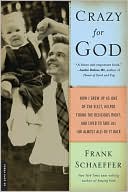
Crazy for God

I ordered Frank Schaeffer’s Crazy for God (subtitled “How I grew up as one of the elect, helped found the religious right, and lived to take all—or almost all—of it back”) as part of my research for The Babylonian Codex. I thought I’d just skim it, focusing on the parts where he talks about his and his famous father’s contributions to the rise of the radical Christian right and the formation of the Moral Majority, and then toss the book in the library donation box.
Boy was I wrong.
This is a story told with brutal honesty and a rare and penetrating wit. It begins, “You can be the world’s biggest hypocrite and still feel good about yourself. You can believe and wish you didn’t. You can lose your faith and still pretend, because there are bills to be paid, because you are booked up for a year, because this is what you do…”.
From there, Crazy for God takes the reader on a journey that is part autobiography, part magical mystery tour. Whether he is writing of his bizarre childhood growing up wild at his parents’ utopian evangelical mission in Switzerland (where guests included the likes of Timothy Leary and Led Zeppelin) or his equally fascinating stint as a boarder in the world of England’s elite public schools in the sixties and seventies, Schaeffer introduces us to an unforgettable cast of colorful and deftly drawn personalities. Ironically, the book actually focuses very little on the part of his life’s story that prompted me to buy it in the first place. I didn’t care. A gifted storyteller and brilliant analyst of character, Schaeffer made me laugh out loud, wince, and think long and hard about everything from family life and parental love to the ways in which the people we meet affect the course of our lives.
I’m not normally a fan of autobiography, but I sat up late into the night reading this one, unable to put it down. The truth is, it’s been a long time since I enjoyed a novel as much.
The library sale isn’t getting this one.
Thursday, September 03, 2009
Hot Buttons
Do you have a situation/conflict/kind of character you just can’t read about?
I ran across one last night. I’ve been meandering my way through Snow Falling on Cedars and rather enjoying it until the story suddenly grated across my worst, I-don’t-want-to-read-about-it, don’t-want-to-think-about-it issue. So what’s my hot button?
A character getting cheated out of or foolishly losing his money.
I know, I know; this says volumes about me and none of it is nice. But it's one of my worst nightmares and I don't want to go there.
I know people who can’t read about the murder of children (I have a hard time with that one, but it won’t stop me cold). Other friends say they can’t read about a character who commits adultery.
So what’s your “hot button”?
I ran across one last night. I’ve been meandering my way through Snow Falling on Cedars and rather enjoying it until the story suddenly grated across my worst, I-don’t-want-to-read-about-it, don’t-want-to-think-about-it issue. So what’s my hot button?
A character getting cheated out of or foolishly losing his money.
I know, I know; this says volumes about me and none of it is nice. But it's one of my worst nightmares and I don't want to go there.
I know people who can’t read about the murder of children (I have a hard time with that one, but it won’t stop me cold). Other friends say they can’t read about a character who commits adultery.
So what’s your “hot button”?
Wednesday, August 26, 2009
Are You Visual or Aural?
Can the way we like to learn also influence the way we write and the kinds of books we like to read?
This interesting concept was suggested to me by Sabrina Jeffries, a NYT bestselling romance writer who recently visited our Monday night writers group (she was in town visiting her agent and critique partner of many years, both of whom are members of the group). She said she was an aural learner, and she thought that’s why she didn’t like putting a lot of visual description in her books and becomes inpatient with writers who do. (She also said where she picked up this interesting concept, but I was so focused on the idea itself that I didn’t hear that part.)
It’s an intriguing idea. I Googled learning styles and discovered that, yes, our preferred learning styles do influence more than just they way we prefer to study. They also affect the way we internally represent experiences, the way we recall information and the words we choose. So it makes sense that they would influence the way we write and whether or not we like James Lee Burke.
There are actually several different approaches to learning:
Visual (spatial): prefers using pictures, images, and spatial understanding.
Aural (auditory-musical): prefers using sound and music.
Verbal (linguistic): prefers using words, both in speech and writing.
Physical (kinesthetic): prefers using body and sense of touch.
Logical (mathematical): prefers using logic, reasoning and systems.
Social (interpersonal): prefers to learn in groups or with other people.
Solitary (intrapersonal): prefers to work alone and use self-study.
Although we usually have a dominant learning technique, most people use a combination of these approaches. The same person can even use different styles in different situations. My kids, for instance, learned better when they could move around (works great for memorizing spelling words at home, but not so good in a classroom situation when everyone is expected to sit down). My daughter also discovered she could remember her French vocab words if she wrote them on colored cards: blue for masculine nouns, pink for feminine. But our styles are not fixed; we can develop our abilities in our less dominant styles. And each of these styles uses a different part of the brain, so the more areas of the brain we use when learning, the better we remember.
I guess my exercise with the colored note cards shows that I’m very visual. My card system also betrays that I’m very logical; I like to diagram things out and classify information. But I’m also highly aural: I remember material I hear in a lecture better than I remember what I read, just as I learn the words of songs or poems I hear very quickly. Unfortunately, I am not at all kinesthetic; when my girls and I were taking Tae Kwan Do, they’d learn our belt pattern the first night and then spend the next three months trying to drill it into my thick head. I’m also a solitary rather than a social learner: no study groups for me.
How about you? How do you think your personal learning style influences your writing or reading?
This interesting concept was suggested to me by Sabrina Jeffries, a NYT bestselling romance writer who recently visited our Monday night writers group (she was in town visiting her agent and critique partner of many years, both of whom are members of the group). She said she was an aural learner, and she thought that’s why she didn’t like putting a lot of visual description in her books and becomes inpatient with writers who do. (She also said where she picked up this interesting concept, but I was so focused on the idea itself that I didn’t hear that part.)
It’s an intriguing idea. I Googled learning styles and discovered that, yes, our preferred learning styles do influence more than just they way we prefer to study. They also affect the way we internally represent experiences, the way we recall information and the words we choose. So it makes sense that they would influence the way we write and whether or not we like James Lee Burke.
There are actually several different approaches to learning:
Visual (spatial): prefers using pictures, images, and spatial understanding.
Aural (auditory-musical): prefers using sound and music.
Verbal (linguistic): prefers using words, both in speech and writing.
Physical (kinesthetic): prefers using body and sense of touch.
Logical (mathematical): prefers using logic, reasoning and systems.
Social (interpersonal): prefers to learn in groups or with other people.
Solitary (intrapersonal): prefers to work alone and use self-study.
Although we usually have a dominant learning technique, most people use a combination of these approaches. The same person can even use different styles in different situations. My kids, for instance, learned better when they could move around (works great for memorizing spelling words at home, but not so good in a classroom situation when everyone is expected to sit down). My daughter also discovered she could remember her French vocab words if she wrote them on colored cards: blue for masculine nouns, pink for feminine. But our styles are not fixed; we can develop our abilities in our less dominant styles. And each of these styles uses a different part of the brain, so the more areas of the brain we use when learning, the better we remember.
I guess my exercise with the colored note cards shows that I’m very visual. My card system also betrays that I’m very logical; I like to diagram things out and classify information. But I’m also highly aural: I remember material I hear in a lecture better than I remember what I read, just as I learn the words of songs or poems I hear very quickly. Unfortunately, I am not at all kinesthetic; when my girls and I were taking Tae Kwan Do, they’d learn our belt pattern the first night and then spend the next three months trying to drill it into my thick head. I’m also a solitary rather than a social learner: no study groups for me.
How about you? How do you think your personal learning style influences your writing or reading?
Saturday, November 08, 2008
You Can’t (Usually) Go Home Again
One of my favorite books of all time is M.M. Kaye’s Trade Wind. I fell in love with it when I was quite young, and have reread it with equal pleasure several times over the years. So when I came upon Kaye’s Death in Zanzibar at the recent Friends of the Library Booksale, I considered it a find.
If you’re not familiar with the two books, Death in Zanzibar is a whodunit from the fifties, very much in the style of Agatha Christie. In writing the “modern” murder mystery, Kaye conceived a backstory involving a rakish nineteenth-century English outlaw/privateer, a prudish American do-gooder, and a trove of hidden treasure. In one of those fascinating twists of the creative process, she found herself so obsessed with her “backstory” that she later went on to write that story, too, in a sprawling historical novel that became Trade Wind.
I remember checking Death in Zanzibar out of my local library in the seventies, and being swept away by lush descriptions of the island and its culture. So I thought I was in for a real treat when I started reading it last week—“thought” being the operative word in that sentence. To begin with, where’s the island? I’m now half way through the book, and we’re still on the plane! Why didn’t I remember that part of the book? Obviously, because it wasn’t memorable. Yet I intend to continue reading, not because I’m enjoying the story (I’m not) , but because the book itself is an eye-opening period piece.
First of all, it’s taking our heroine days to get to Zanzibar; that’s what international travel was like in the fifties. I myself have vague memories of flying back and forth to Europe as a child and having to stop and spend the night in the Azores (okay, I know I’m really dating myself here!). Yet if I were to read this book without looking at the copyright date, I suspect I’d guess it was written in the thirties, rather than in the fifties. Ladies wear lovely linen suits and hats, and young women traveling alone are ever-so-careful of their reputations. A flamingly gay secretary is caricatured in a most politically incorrect way, as is the Westernized Oriental Gentleman (aka Wog, for those of you familiar with overt mid-twentieth century British racism), who is portrayed as a sinister character largely by virtue of being labeled a “nationalist” who wants to kick the benevolent British out of their God-given colonies. Oh, and then there’s all the talk about the evil “Reds.”
Sadly, Death in Zanzibar is a novel that has not aged well in the way of, say, To Kill a Mockingbird, or Huckleberry Finn, or even Kaye’s own Trade Wind. It occurs to me now that all three of those novels were actually “historicals” at the time they were written, even though the first two were set within the remembered lifetimes of their authors. Which is a thought I hope to ponder, at a later date.
If you’re not familiar with the two books, Death in Zanzibar is a whodunit from the fifties, very much in the style of Agatha Christie. In writing the “modern” murder mystery, Kaye conceived a backstory involving a rakish nineteenth-century English outlaw/privateer, a prudish American do-gooder, and a trove of hidden treasure. In one of those fascinating twists of the creative process, she found herself so obsessed with her “backstory” that she later went on to write that story, too, in a sprawling historical novel that became Trade Wind.
I remember checking Death in Zanzibar out of my local library in the seventies, and being swept away by lush descriptions of the island and its culture. So I thought I was in for a real treat when I started reading it last week—“thought” being the operative word in that sentence. To begin with, where’s the island? I’m now half way through the book, and we’re still on the plane! Why didn’t I remember that part of the book? Obviously, because it wasn’t memorable. Yet I intend to continue reading, not because I’m enjoying the story (I’m not) , but because the book itself is an eye-opening period piece.
First of all, it’s taking our heroine days to get to Zanzibar; that’s what international travel was like in the fifties. I myself have vague memories of flying back and forth to Europe as a child and having to stop and spend the night in the Azores (okay, I know I’m really dating myself here!). Yet if I were to read this book without looking at the copyright date, I suspect I’d guess it was written in the thirties, rather than in the fifties. Ladies wear lovely linen suits and hats, and young women traveling alone are ever-so-careful of their reputations. A flamingly gay secretary is caricatured in a most politically incorrect way, as is the Westernized Oriental Gentleman (aka Wog, for those of you familiar with overt mid-twentieth century British racism), who is portrayed as a sinister character largely by virtue of being labeled a “nationalist” who wants to kick the benevolent British out of their God-given colonies. Oh, and then there’s all the talk about the evil “Reds.”
Sadly, Death in Zanzibar is a novel that has not aged well in the way of, say, To Kill a Mockingbird, or Huckleberry Finn, or even Kaye’s own Trade Wind. It occurs to me now that all three of those novels were actually “historicals” at the time they were written, even though the first two were set within the remembered lifetimes of their authors. Which is a thought I hope to ponder, at a later date.
Thursday, February 14, 2008
On Abandoning a Book Unfinished.
My Monday night writers group has coined a word to describe the act of abandoning a book unfinished: proctorizing. Obviously, this is something I do frequently—far more than anyone else in the group—although I’ve noticed they do it more and more these days. They’ll come in and say, “I started So-and-so’s latest, but I proctorized it after about a hundred pages,” and then go on to analyze why.
There was a time when I religiously finished every book I started, even if I wasn’t enjoying it. When I was a child, I knew I liked some books better than others, but I never analyzed why. I had this naive belief that if a book was published, then it was somehow anointed as worthy of being read.
As I grew, I came to understand the differences between popular fiction and the classics, but I still finished every book I began. At some point, one of my teachers handed out a list entitled One Hundred Novels Every Educated Person Should Have Read. I don’t know who compiled that list, but I was determined to be labeled an Educated Person. As I grimly plowed through one after the other of the books on that list, year after year, I experienced some wonderful books I probably never would have read otherwise. I also encountered some real stinkers. But when I found my attention wandering, I naturally attributed it to a failing on my part. After all, who was I to say Fitzgerald sucks?
It wasn’t until I was in college and began reading more modern popular fiction that I finally realized that yes, really awful books get published—and hit the bestseller lists—all the time. Just because some idiot editor let this tripe into print didn’t mean I had to waste my precious reading time finishing it.
Sometimes I put a book aside and go back to it later, thinking a change of mood might improve my reception of the story. At other times I can appreciate a book’s merit, but realize that for one reason or another it’s not for me. But frequently I abandon books in something close to a rage because the author has really, really annoyed me. For the sake of market research, I will at times try to continue those books for a while, hoping to understand what it is about a particular bestseller that explains its appeal. I’ve come to realize that clunky writing, silly factual errors, gaping plot holes, thin characters, predictable or implausible situations don’t seem to bother most people.
We all read for our own reasons, and find pleasure in our own combination of factors. But with so many books out there to read, and the time for reading them shrinking every day, I find myself less and less willing to tolerate a book that fails to sweep me away in that magical way I first came to love as a child. Which is why I proctorize so many books.
There was a time when I religiously finished every book I started, even if I wasn’t enjoying it. When I was a child, I knew I liked some books better than others, but I never analyzed why. I had this naive belief that if a book was published, then it was somehow anointed as worthy of being read.
As I grew, I came to understand the differences between popular fiction and the classics, but I still finished every book I began. At some point, one of my teachers handed out a list entitled One Hundred Novels Every Educated Person Should Have Read. I don’t know who compiled that list, but I was determined to be labeled an Educated Person. As I grimly plowed through one after the other of the books on that list, year after year, I experienced some wonderful books I probably never would have read otherwise. I also encountered some real stinkers. But when I found my attention wandering, I naturally attributed it to a failing on my part. After all, who was I to say Fitzgerald sucks?
It wasn’t until I was in college and began reading more modern popular fiction that I finally realized that yes, really awful books get published—and hit the bestseller lists—all the time. Just because some idiot editor let this tripe into print didn’t mean I had to waste my precious reading time finishing it.
Sometimes I put a book aside and go back to it later, thinking a change of mood might improve my reception of the story. At other times I can appreciate a book’s merit, but realize that for one reason or another it’s not for me. But frequently I abandon books in something close to a rage because the author has really, really annoyed me. For the sake of market research, I will at times try to continue those books for a while, hoping to understand what it is about a particular bestseller that explains its appeal. I’ve come to realize that clunky writing, silly factual errors, gaping plot holes, thin characters, predictable or implausible situations don’t seem to bother most people.
We all read for our own reasons, and find pleasure in our own combination of factors. But with so many books out there to read, and the time for reading them shrinking every day, I find myself less and less willing to tolerate a book that fails to sweep me away in that magical way I first came to love as a child. Which is why I proctorize so many books.
Thursday, May 24, 2007
Are You Impressed Yet?
According to the March 2007 Library and Information Update, one third of readers surveyed said they read “challenging literature” in order to be perceived as being well read, even though they couldn’t follow what the book was about. One half said reading classics makes people look more intelligent, while forty percent lied about having read certain books. Another survey found that half of their respondents admitted to having bought a book simply to leave it lying around the house looking impressive.
Topping the list of books people admitted they bluffed about having read: Lord of the Rings, War and Peace, Withering Heights, 1984, Harry Potter, Great Expectations, Jane Eyre, The Da Vinci Code, and The Diary of Anne Frank.
If you think that’s scary, think about this: these are the honest liars. How many people buy books to impress their friends or claim to read books they haven’t, yet don’t admit it?
Topping the list of books people admitted they bluffed about having read: Lord of the Rings, War and Peace, Withering Heights, 1984, Harry Potter, Great Expectations, Jane Eyre, The Da Vinci Code, and The Diary of Anne Frank.
If you think that’s scary, think about this: these are the honest liars. How many people buy books to impress their friends or claim to read books they haven’t, yet don’t admit it?
Monday, October 16, 2006
What Liddell Hart Knew Fifty Years Ago
(Above: Photo of Liddell Hart from Wiki Commons.)
I’ve finished the penultimate draft of WHY MERMAIDS SING. Since I’m comfortably ahead of my 1 November deadline, I can set it aside for a week, then come back to it and do a final read-through before I run off the final copy and send it off to my editor. Now I must turn my attention to getting my office into some semblance of order before I embark on the mad rush to finish THE ARCHANGEL PROJECT for Harper Collins.
What I’m reading… STRATEGY, by B. H. Liddell Hart. I didn’t buy this at the booksale, but I did find it on my shelves while trying to make room for all my new purchases. Fascinating book. If you’re not familiar with Liddell Hart, he was the British military historian probably best known for an insightful book written before World War II on the future uses of tanks and air power in warfare. His fellow Brits scoffed at his conclusions and recommendations. The German General Staff did not…
Anyway, in this book, Liddell Hart analyzes military strategy through the ages, starting with the Greeks and plowing his way forward. But I was particularly caught by his final chapter on Guerrilla War, added to the 1967 edition I have. In this chapter, he cautions against the desirability of guerrilla warfare as fomented by the Allies as a resistance to the Nazis in WWII, by Lawrence against the Turks in WWI, by the Spaniards against Napoleon. I will simply quote:
“Violence takes much deeper root in irregular warfare than it does in regular warfare. In the latter it is counteracted by obedience to constituted authority, whereas the former makes a virtue of defying authority and violating rules. It becomes very difficult to rebuild a country, and a stable state, on a foundation undermined by such experience.
“A realization of the dangerous aftermath of guerrilla warfare came to me in reflection on Lawrence’s campaigns in Arabia. My book on those campaigns, an exposition of the theory of guerrilla warfare, was taken as a guide by numerous leaders of commando units and resistance movements in the last war. Wingate, then only a captain serving in Palestine, came to see me shortly before it started, and was obviously filled with the idea of giving the theory a fresh and wider application. But I was beginning to have doubts—not of its immediate efficacy, but of its long-term effects. It seemed that they could be traced, like a thread, running through the persisting troubles that we, the Turks’ successors, were suffering in the same area where Lawrence had spread the Arab Revolt….
“These lessons of history were too lightly disregarded by those who planned to promote violent insurrections as part of our war policy. The repercussions have had a shattering effect in the postwar years on the peace policy of the Western Alliance—and not only in providing both equipment and stimulus to anti-Western movements in Asia and Africa. The disease has continued to spread.
“It is not too late to learn from the experience of history. However tempting the idea may seem of replying to our opponents’ “camouflaged” war activities by counter-offensive moves of the same kind, it would be wiser to devise and pursue a more subtle and far-seeing counter-strategy. In any case, those who frame policy and apply it need a better understanding of the subject than has been shown in the past.”
Ah, if only the CIA had read and reflected upon that chapter before rushing to organize, aid and arm the Islamic fundamentalists’ resistance to the Russians in Afghanistan. And think, for a moment, on the implications of this insight for the future of Iraq…
Sunday, September 24, 2006
Superstrings
I’m reading THE ELEGANT UNIVERSE: Superstrings, Hidden Dimensions and the Quest for the Ultimate Theory, by Brian Greene. Greene is a quantum physicist at Cornell and Columbia. In this book, Greene confronts the “dirty little secret” of physics, namely that as currently formulated, general relativity and quantum mechanics cannot both be right. General relativity seems to explain the behavior of the universe on a large scale, while quantum mechanics describes the behavior of subatomic particles. Since, in our specialized society, scientists typically study either the universe OR subatomic particles but not both, this incompatibility of their guiding theories doesn’t pose much of a problem on a day-to-day basis. But this doesn’t alter the fact that both can’t be right. Greene believes the two theories can be resolved by the superstring theory. Of course, the problem with the superstring theory is it can’t be proved and hasn’t all been worked out yet. In fact, I saw the other day that two books have recently come out attacking the effect of the superstring theory on modern physics.
Why am I reading this book? Because I never studied physics at university and I’ve recently started feeling a lack in my understanding of things (mainly while doing research for a book idea). I’m not sure I’d recommend Greene’s book. It’s not an easy read, and that’s not simply the fault of his subject matter. For example, he’ll give a simplified explanation of something in Chapter 2 that will leave me thinking, “But what about xyz? This doesn’t make sense.” Then in Chapter 4, he’ll say, “You may have been puzzled in Chapter 2 because you thought, ‘What about XYZ?’ That’s because the explanation was simplified.” Then he’ll go on to explain XYZ. Perhaps, given the subject matter, there is no other way to explain it to a layperson. I intend to read more books on the subject, but it’s going to take me a while to wade through this one, so don’t hold your breath.
A few weeks ago I read THE FIELD, by Lynne McTaggart. This is description of discoveries that point to a unifying concept of the universe reconciling Newtonian science with quantum physics. Her focus is on the “zero point field,” the microscopic vibrations in space and within and between physical objects on earth, i.e., basically, superstrings. McTaggart is an investigative journalist, and while her website leads one to suspect she’s rather flaky, her book at least seems solidly researched and footnoted. It includes some intriguing information that does seem to support the superstring theory, but she doesn’t provide the solid understanding of physics provided by someone like Greene.
What I’m reading for fun: BUDDHA IN YOUR BACKPACK, by Franz Metcalf. If reading a book on Buddhism doesn’t sound like your idea of light reading, let me hasten to add that the book is aimed at teenagers. Plus, remember it’s in comparison to the above!
Why am I reading this book? Because I never studied physics at university and I’ve recently started feeling a lack in my understanding of things (mainly while doing research for a book idea). I’m not sure I’d recommend Greene’s book. It’s not an easy read, and that’s not simply the fault of his subject matter. For example, he’ll give a simplified explanation of something in Chapter 2 that will leave me thinking, “But what about xyz? This doesn’t make sense.” Then in Chapter 4, he’ll say, “You may have been puzzled in Chapter 2 because you thought, ‘What about XYZ?’ That’s because the explanation was simplified.” Then he’ll go on to explain XYZ. Perhaps, given the subject matter, there is no other way to explain it to a layperson. I intend to read more books on the subject, but it’s going to take me a while to wade through this one, so don’t hold your breath.
A few weeks ago I read THE FIELD, by Lynne McTaggart. This is description of discoveries that point to a unifying concept of the universe reconciling Newtonian science with quantum physics. Her focus is on the “zero point field,” the microscopic vibrations in space and within and between physical objects on earth, i.e., basically, superstrings. McTaggart is an investigative journalist, and while her website leads one to suspect she’s rather flaky, her book at least seems solidly researched and footnoted. It includes some intriguing information that does seem to support the superstring theory, but she doesn’t provide the solid understanding of physics provided by someone like Greene.
What I’m reading for fun: BUDDHA IN YOUR BACKPACK, by Franz Metcalf. If reading a book on Buddhism doesn’t sound like your idea of light reading, let me hasten to add that the book is aimed at teenagers. Plus, remember it’s in comparison to the above!
Saturday, July 01, 2006
Bending Reality to the Breaking Point
I’ve been limping my way through you-know-who's ANGELS AND DEMONS, and it’s led me to give more thought to a point I touched upon here the other day: authors who twist or ignore facts for the convenience of their plots, or simply fail to invest the time to check their facts before they sit down to write.
Now, I don’t have a problem with bending reality a bit; we are talking fiction here. And everyone, no matter how careful, makes mistakes; God knows I’ve done it myself. But I quickly lose interest in a book—and respect for an author—when someone who’s supposed to be writing a suspense, romance, thriller, or mystery acts like he’s writing science fiction and can just make stuff up as he goes along. Big, important stuff.
Thus we have thrillers in which Saddam Hussein—a dedicated secularist—is hobnobbing with Islamic fundamentalists, medieval romances where the heroine acts and talks like a Valley Girl, and mysteries where a hurricane is about to hit New Orleans during Mardi Gras. In my current read, for example, our author would have us believe that the world is watching, breathless, as the Catholic church prepares to elect a new pope, yet the BBC has only sent one journalist—and a newly-hired one at that. Is Dan Brown that naive, or does he simply assume most of his readers are? Better yet, consider the central premise of the plot: a bunch of loonies are about to blow up the middle of Rome, yet four incredibly inexperienced people—one a priest, one a scientist, another a Harvard scholar—take it upon themselves not to tell anyone? A plot device, obviously; calling in the Italian army and every expert from across Europe would have left our heroine and hero with precious little to do. Yet the situation is so silly, and so obviously not what would happen, that I would expect most people to groan and throw the book across the room. From looking at the book’s sales record, however, that obviously isn’t happening. And don’t get me started on all the historical mistakes in the Da Vinci Code.
So am I unusual in finding my pleasure destroyed by this kind of gross inaccuracy?
Thursday, June 29, 2006
On Audio Books
I’ve been giving some more thought to the experience of listening to audio books vs. reading them. I have yet to enjoy a novel I’ve listened to, and I’m beginning to wonder if my reaction to those books was influenced by the fact I was listening to them rather than reading them.
One of the problems with listening to a book rather than reading it is that it seems to engage less of my brain. Thus, when a character does something unbelievable, or a plot hole yawns wide, or a writer seriously gets her facts wrong, I find my mind spinning off into prolonged analysis and contemplation of these failings even as I continue listening to the story. I suspect if I were reading the book, I would simply note the problem, then move on.
Another factor is one of speed. The book I’m listening to at the moment has massive tons of description. Now, I like description, so if I’m finding myself wishing I could skim, you know we’re talking serious overdoses of travelogue. This author also writes loooong scenes that do nothing to move the plot but are intended simply to show characterization (I personally think a scene should do both); if I could skim or skip them, I might find the book more enjoyable…although I would still have to put up with her Too Stupid to Live heroines and serious lack of understanding of how an archaeological dig works or what 800 years in the dirt would do to a brass and silver buckle.
I suppose the only way to test this theory would be to listen to a novel by an author I know and respect. Which is what I’ll probably do next.
In contrast, I find I enjoy listening to nonfiction. I suppose the experience is similar to listening to a good lecture. The problem there is that, as I drive down the street, I find myself wishing I could take notes! As a result, the two nonfiction books I’ve listened to most recently are now sitting on my bookshelves.
Monday, June 05, 2006
Audio Books: How Bad Does It Have to Be Before You Hit Eject?
I’ve been thinking about audio books versus the paper versions. I just finished listening to a book I never would have finished if I’d been reading it. Reading a book requires me to pick it up time and again or continue reading through distractions, while listening to a book in my car simply obliges me to resist hitting a button to change to a radio station.
I actually had decided to quit listening to this particular book—a mystery thriller—but then forgot to get something else when I drove up to the lake house to meet the electrician the other day. So I ended up finishing it after all. Not entirely a waste of time, since one can learn much from a poorly executed book.
This book was interesting because the writer did some things very, very well, even though she did other things so badly. I wonder if the things that irritated me—the unrealistic characters, the self-obsessed heroine—would have irritated other readers. The heroine was supposed to have been a rebellious little rich girl wild child who became a cop. I had a really hard time swallowing that. (FBI agent, maybe; but a common cop?) Worse, she was a narcotics agent. The wild children I knew in my misspent youth hated all cops, but reserved a particular contempt for “narcs.” So that aspect of the book kept yanking my “I don’t believe this” response, which kept pulling me out of the story. Worse, the devices that were intended to make me sympathetic to the heroine kept irritating me—it reached the point that I was groaning every time she started contemplating suicide and staring at herself naked in front of a mirror.
Most of the other characters in the book were not so much characters as caricatures. The over-tanned Florida Jew with the New York accent and the cigarette hanging out of her mouth, the oily European who kept talking about “stupid Americans,” the “overfed” teenager—in fact, I was about halfway through the book when I realized that the only characters the writer had respect for were the heroine and one little girl. Even the two dogs and the cat in the story were portrayed as obnoxious. It left a bad taste in my mouth.
The author of this disaster has been hitting the New York Times bestseller lists for a good ten years now, yet she still sprinkles her book with dozens and dozens of clichés: heavy as lead, spinning like a top, bright as a new penny. I kept wondering what happened to her editor’s red pencil. But by far the most serious flaw was the story’s complete lack of surprise. No plot twists, nothing unexpected until the final twist at the end, which was indeed a twist but failed by being unbelievable.
All of which has made me think a lot about the importance of respecting my characters, and maintaining surprise and freshness in my stories. Always useful reminders. But the next book I listen to is going to be something well done, that I can enjoy.
Saturday, May 06, 2006
The Reading Writer
It occurred to me today that I’ve been reading far more nonfiction lately than fiction. At first I blamed Katrina; John Connelly’s BLACK ANGEL was the first novel I actually managed to read all the way through since the storm. Yet I’ve read a fair number of nonfiction books in the last eight months. My reading time has been seriously curtailed by the realities of our lives these days, yet there must be a reason I’ve been able to stick with nonfiction and not fiction.
I suppose it’s one of the dangers of being a writer. We read our own writing so critically, constantly looking for flaws, that it becomes a habit. And so we bring that same critical judgment to the novels we pick up. I used to open a book expecting to be entertained. Now it’s a rare novel that can carry me away into its story enough that I turn off that internal editor, the voice that says, Poor Character Motivation. Predictable Plotting. Clunky Dialogue.
The other day my younger daughter came home from school. She said she and a group of friends had been discussing a new movie and when my daughter said “But it had so many plot holes!” everyone looked at her and said, “What’s a plot hole?” Both my daughters are always telling me I’ve ruined movies for them. Now I’m beginning to wonder if I’ve ruined the joy of reading novels for myself.
Subscribe to:
Posts (Atom)