
When I first started thinking about my annual Katrina anniversary post, I searched for just the right photos to illustrate it. But I won't be using them. After spending the weekend watching what Hurricane Irene did to the east coast, I just can't look at any more flooded streets, any more shattered houses, any more white swirling clouds. So instead, for anyone and everyone savaged by this latest storm, this song's for you:
,
**
While hurricane season technically lasts from 1 June to 1 December, everyone in New Orleans knows that the truly dangerous period extends for three weeks on either side of 10 September. It's during that nasty six week window that the Gulf is at its hottest and conditions are somehow ripe for funneling killer storms our way. Betsy, Camille, Katrina, Rita, Gustav, Ike...they all fell within that six week period
This is the time of year when I just sort of hunker down, shut my eyes, grit my teeth, and wait for it all to be over.
Monday will be the sixth anniversary of Katrina. Next year will be seven; soon it will have been a decade, then a quarter century. With every year, Katrina recedes farther and farther into the past. I recently reread some of the posts I wrote in the months after the storm, and I was frankly astonished at the number of the things I'd forgotten from those days. But one thing I remember quite clearly about the weeks after Katrina is the way people kept playing Green Day's Wake Me Up When September Ends. Our houses were either open to the sky or protected by flimsy blue tarps; water was still standing everywhere; the levees were battered, weakened, or gone. We knew if another hurricane hit the city, at that point, all truly would be over. So we watched the sky, and hoped, and held our breath, and waited for that six-week danger period to be over...for September to end.
Sunday, August 28, 2011


Tuesday, August 23, 2011
The English Patient

Although I enjoyed the movie The English Patient when I saw it in a theatre in Adelaide some years ago, I did not read the book. It was described as being “dense” and “inaccessible,” and since I generally have a low tolerance for self-consciously “literary” books, I was never tempted to have anything to do with it.
Well, a few weeks ago my daughter was cleaning out her bookshelves and one of the books she set aside was a trade paperback edition of The English Patient. I picked it up and said, “Are you getting rid of this?” She said, Yes; she hadn’t enjoyed it and could never really “get into it.” My plan was simply to flip through it and then toss it in the pile for the library book sale. To my surprise, not only did I end up reading the entire book (remarkable in itself, since these days I give up on probably nine out of ten books I begin), but I actually enjoyed it. And now I’m left pondering all those adjectives that we hear so frequently applied to it.
Yes, it is nonlinear, but I did not find it difficult to follow. The characters were rich, the language wonderful, and the insights into the human condition thought provoking. (The heroine’s response to the dropping of the atomic bombs on Japan, “If we can rationalize this, we can rationalize anything,” echoes within me still.) But dense? Inaccessible? I don’t think so. And the ending, while only slightly different from the film version, did not leave me with that wretched sense of sadness that characterized the movie.
The book does, however, require a slightly altered frame of mind. I suspect enjoyment hinges on the reader appreciating that the book is not an attempt to recreate a realistic slice of life but necessitates an approach vaguely similar to the way one would read a fable or a fairy tale. Perhaps it’s that shift in thought pattern that so many readers find themselves unable to make—or uninterested in making. Or perhaps one must simply be in a certain mood, and the book and I happened to meet at the right place and the right time. Perhaps if I’d tried it ten years or even ten months ago I’d have hated it, too. I did say I have a low tolerance for self-consciously literary books, didn’t I?
Have you ever had that experience? Pick up a book and hate it, and then try it again at a different time and enjoy it?

Wednesday, August 10, 2011
Whiskies in a Box and Co.

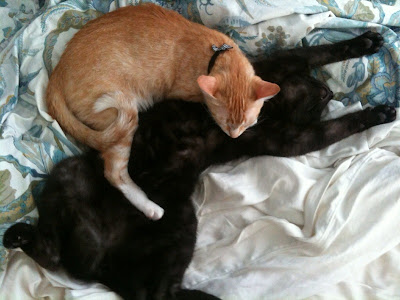
Whiskies is one of the kittens born to the mama cat my daughter found abandoned in a state park up in Arkansas two years ago on 4 August (a birthday they share with our President). She managed to find a home for the mama cat and one of the kittens, but we still have three kittens left: Whiskies, Roscoe, and Peanut. Whiskies had trouble being born and is slightly retarded as a result, which is a polite way of saying he's the dumbest cat I've ever met. He doesn't know how to meow and can only make squeaking noises like a pig. He also doesn't seem to know when he's full, so he eats constantly. But he's a lovable little (big?) sweetheart who really, really doesn't fit in a shoebox.
Here is Whiskies's sister, Peanut (with her adopted brother, Oden). Peanut was the runt of the litter and has a thyroid problem. As a result, she's about 1/4 the size of Whiskies. People who don't know better think she's about twelve weeks old.

And last but not least, here's Roscoe:

Unfortunately, I could only find an old photo of Roscoe from last Halloween, although he hasn't changed much. I always thought he'd grow up to be a big tomcat, but he's still fairly small.
A few weeks ago, my daughter went to Mississippi and brought this home...

She'd just had puppies, but the puppies didn't make it and she almost didn't either. Her name is now Bella, and she's looking much better...

I told my daughter she's not allowed to leave the state ever again.
Sunday, July 31, 2011
Peaceful Coexistence

This cat and chicken live around the corner from my mom's old house. The owner is a little old man; sometimes the three of them will sit out on the porch together, but usually it's just the cat and the chicken. We've been trying to get a picture of them for ages, and Steve finally managed it this past weekend.
Talk about unlikely friends....
Wednesday, July 27, 2011
Language Usage in Historicals
**
I’m in the midst of one of my least favorite writing tasks—going over the copyedited manuscript for When Maidens Mourn (Sebastian Number Seven). This manuscript has very, very few copyeditor’s balloons in it (to the point I’m worrying), but almost every one I’m finding is a query on word usage. As in, “The term ‘jawline’ dates to 1924; please consider rewording.”
As far as I’m concerned, the solution to that one is fairly simple: either leave it as is to conform to modern spelling, or separate it into two words to be true to the period but have the self-proclaimed Grammar Nazis come down on you (well, on me). Roofline (1857) falls into the same category. Hard-pressed (1825) can be changed to sorely pressed. But other words are much harder to deal with. Did you know that booed didn’t enter the dictionary until 1884? So what did they say? Heckled? But that conjures a different image, doesn’t it? Wooden-faced arrived in 1859. Confetti in 1815. Tic in 1834. So, what word did they use before then? Would modern readers even know what it meant, if I could find it?
Complicating all this is the fact that the Powers That Be sometimes get these word origin dates wrong. I remember I changed “tenement” in What Angels Fear because I was told it didn’t come into usage until the mid-century. Since then, I’ve seen it used in a passage from the first decade of the century. (So there.) Likewise, I’m told that Cyprian didn’t come into usage until 1819, yet Beau Brummell gave his famous Cyprians’ Ball in the Argyl Rooms in 1813. Doppelganger entered English language dictionaries in 1851, yet was used by Continental writers as early as 1796 (and is being used by Sebastian St. Cyr in 1812 because, I’m sorry, nothing else will work and we can all assume that Sebastian, clever man that he is, has heard of it). The term toad eater is said to date to 1742; does that mean I can use ‘toadying,’ even though it wasn’t in dictionaries until 1859?
Even trickier are words like chain gang, supposedly not used until 1834. Except that French prisoners of war were set to work in chain gangs. So what did they call them? I suspect chain gangs. I changed "guttersnipe" (1869) to tatterdemalion, which is true to the period but will doubtless send my readers scurrying for their own dictionaries.
The truth is, words frequently enter the English language because they fill a vacant niche. What did we use before we borrowed schadenfreude from the Germans? And is there another word that quite conveys the image of starburst (1959)?
So I change queried words when I can find a way around them. But if I can’t come up with something that says what I want to say without sounding awkward or imprecise, I’ll leave a word—like self-congratulatory (1833)-- even though the dictionaries say it wasn’t yet in use. Because I’m writing a story, not a dictionary.
**
Subscribe to:
Posts (Atom)


