Showing posts with label Plotting. Show all posts

Thursday, December 17, 2015

Why I Did it--SPOILER ALERT!

If you haven't yet read Who Buries the Dead, STOP RIGHT NOW! Everyone else can follow me below the cover image for an explanation of a certain event that occurs near the end of that book.


Okay, everyone who hasn't read it stopped above, right? Right? Because you really don't want to spoil it. As the rest of you know, there is a death at the end of Who Buries the Dead; the death of one of my favorite characters. When I first handed in the proposal for this book to my editor, she didn't want me to do it (she really likes this character). But when I explained my reasons, she said, "Yes; you're right."

So what were my reasons?

I should begin by explaining that this character was not originally intended to be part of the continuing cast. I had intended to kill him off in When Maidens Mourn, the first book in which he appeared. But I kinda fell for the guy, and I couldn't do it. Plus I realized what a great and useful character he was, so I let him live. But I never intended for him to live forever. Why?

The main problem is that he is too much like Sebastian. He not only looks like Sebastian, but his character is quite similar, too. For an author, that causes issues. Hopefully those issues didn't show because I worked hard to minimize the effects, but believe me, it was hard.

A second reason is that, once a cast of characters gets too large, it becomes unwieldy. Different readers have their favorites and they tend to be disappointed when Hendon or Kat (yes, some readers do like her!) or whoever doesn't get much page time. For me, plot and pacing are always trumps, so I never bring on a character simply for the sake of spending some time with him or her. But the more characters there are, the harder it becomes to work them all into the plot. The longer this series goes on, the more characters we're adding. That meant some judicial pruning was in order.

I found that in many ways this particular character's scenes were in danger of always hitting the same note. Plus, the more we--and Sebastian--got to know him, the less enigmatic he became. I wanted him to remain something of a mystery; a vaguely ominous threat.

And while this character is gone in one sense, he is not in others. His death is an important catalyst that propels the story arc of Sebastian's personal quest forward. In the next book, When Falcons Fall, Hero and Sebastian travel to Shropshire where they meet Jamie's family and learn a lot more about him, the necklace, and a certain other mysterious figure from the past. I also have a complication involving a little boy that is coming up.

Another factor that influenced my decision, although it was far from the primary one, is the realization that with a series, it becomes increasingly difficult to convince readers that any of the continuing characters are really in danger. If a reader is thinking, "Oh, she wouldn't really kill off Gibson/Hero's mother/Tom," then suspense suffers. Admit it: from now on, you're going to worry more when someone is threatened; right?

I won't deny that I miss Jamie. Because the next book, #11, When Falcons Fall, takes place away from London and thus away from everyone except Sebastian, Hero, and Simon (and Tom, Calhoun, and Claire), I didn't really notice his absence. But I will admit that it pained me when I was writing book #12. And he continues to haunt me. In fact, he haunts me so much that I've been toying with the idea of writing a contemporary mystery series set in New Orleans (although it's hard to find the time, I firmly believe it's a good idea for a series writer to occasionally do other things to keep from getting stale). And I find myself more and more inclined to make the protagonist of that series the descendant of a nefarious London tavern-keeper named Knox....

Monday, February 23, 2015

Radio Interview on WWNO


I'll be doing an interview onTuesday, 24 February, with Susan Larson on The Reading Life, talking about the next Sebastian St. Cyr mystery, Who Buries the Dead. If you live in New Orleans, you can listen to it at 1:30 p.m. Central Time at WWNO 89.9. It will also be rebroadcast this Friday at 7:30 p.m. and Sunday at noon. If you're not in New Orleans, you can listen to it live stream by going to http://wwno.org/listen. You'll also be able to go to the website and find a link to the podcast on the lower right section of the page.


In other news, I've been working on the outline for the twelfth Sebastian St. Cyr book, Where the Dead Lie, although I'm still not quite ready to sit down and write yet.  I've also been doing a ton of interviews and guest blogs for various sites, and I'll be posting those when they go up. 

And I'm gearing up to head out on my book tour next week. Just seven days until Who Buries the Dead hits the stores!

Thursday, February 20, 2014

Card Games

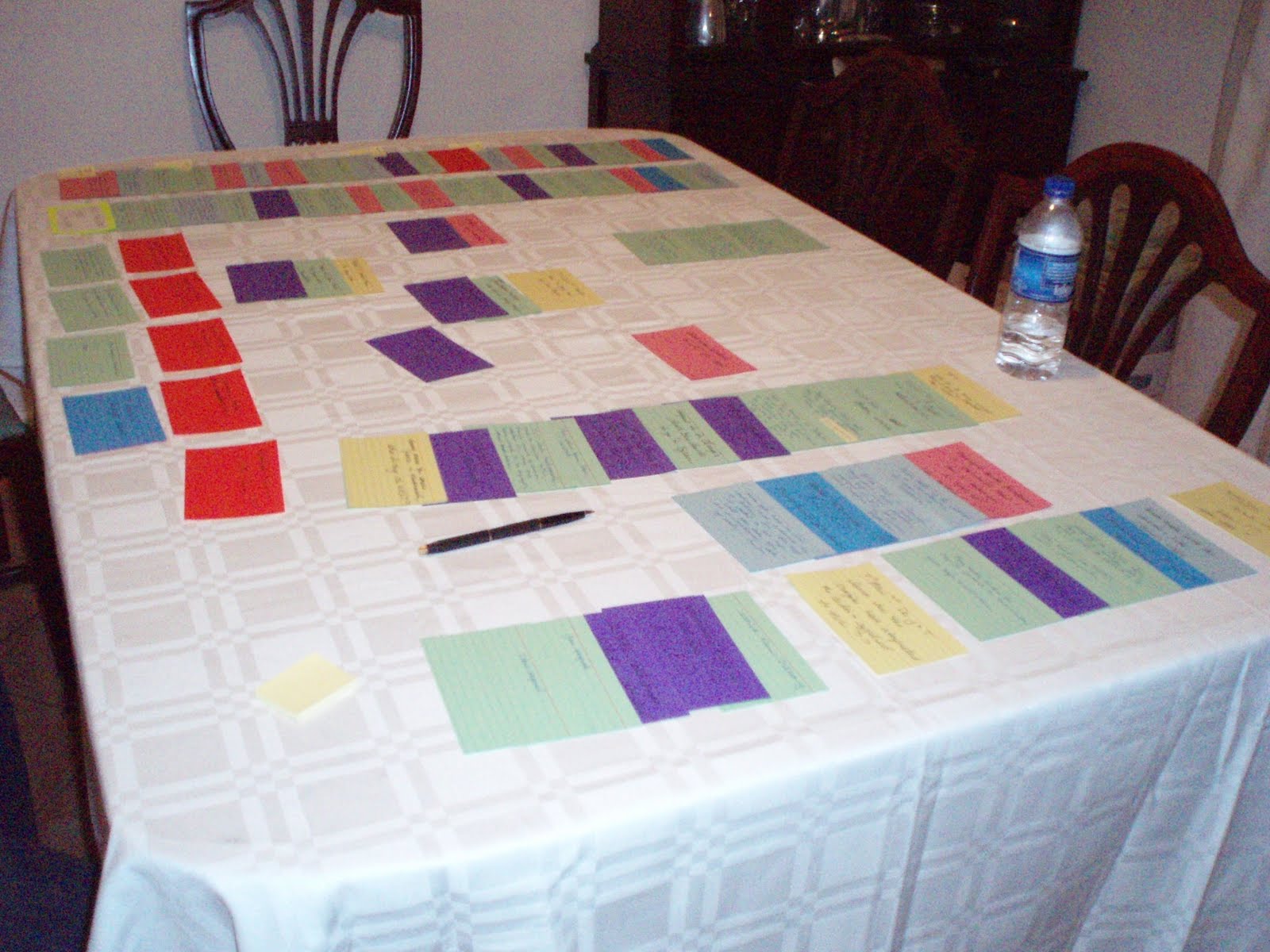
It's plotting time again, which means that I've taken over the dining room table to play with my scene cards.

I'm a very visual plotter. Each card is a scene, and each suspect has his or her own color. Sometimes I give a suspect their own color of card, but this time I simply used little colored flags. The colored Post-It notes on the top of the scene cards also mean something--pink ones are dead bodies, and orange ones are fight/attack scenes. All of this color enables me to see the story arc and structure at a glance. And the blue cards? Those are clues or twists that are still looking for their proper place in the scheme of things; this is very early stage, with only the first dozen or so cards on the far left actually in place. The rest are still in a holding pattern.

This book is proving to be a bit different as it has a very involved "backstory"--the details of the victim's life before she is killed--that also needs to be worked out. Of course, in any mystery, there are always two stories going on at the same time--the events the reader and the detective see, and all the stuff that's happening off stage.

As for a title, that's still open. I'm thinking about using the word "silence" in there, or maybe "children," perhaps with a WHEN or a WHERE, but I'm still waiting for inspiration. Hopefully it will strike soon.

As for Angel, his tests results are back and his numbers are stable, so it's good news!

Tuesday, March 19, 2013

House of Cards


It's that time of year again--when I'm plotting a book, and our dining room table disappears under lines of index cards. My technique is always evolving, but generally involves some combination of color-coded cards and flags. The yellow cards across the top are labeled "Part One" through "Part Eight," since when I'm plotting I find it helpful to divide the book roughly into 50 page chunks. If you see the line of cards closest to the camera, you'll realize that I have the ending of the book plotted out already, along with the beginning; now I'm working out where things will fall in the middle.

The working title of this book--which will be number 10 in the series--is WHO BURIES THE DEAD, and I may actually get to keep that one since my editor has already told me she likes it.

And yes, that is a coffee cup sitting there; my attempt last year to give up caffeine did not work!

Saturday, January 22, 2011

The Lake in Winter


I've spent the past week up at the lake in an intensive effort to finish Why Maidens Mourn (still trying to get used to that title), number seven in the Sebastian St. Cyr series.

My last several writing retreats haven't been particularly successful, although this one wasn't quite the disaster of my November expedition. That one started with my car breaking down. Then about an hour after I finally arrived at the lake, I experienced a plumbing disaster that flooded the main bedroom, a storage closet, and half the kitchen. The entire first day was consumed by such productive exercises as rescuing boxes of papers, books, and photos, pulling up soaked carpet, and mopping (plus doing a lot of swearing). The second day was spent with a shovel and a Roto-Rooter man, digging up the yard in a forlorn attempt to find the clean-out valve for the septic tank (after uncovering the entire line, we discovered there was no clean-out valve). Then, because these things always come in threes, a horde of red ants evidently disturbed by the flood invaded my house and attacked Huckleberry's food bowls. Because my porphyria makes bugsprays as deadly to me as to bugs, the only thing I had to fight back with was Restoration Hardware grapefruit counter spray and pepper.

This time, I only had to contend with the rain and the cold. My sister Penny recently moved to McCall in the mountains of Idaho, so I've added McCall to the weather app on my iPhone and amuse myself occasionally by looking up her temperature and snickering when I see it's, say, -15 degrees in McCall and a balmy 65 in New Orleans. Well, last week it was a balmy 35 degrees in the mountains of Idaho and a bone-chilling 22 at my lake house. Who's snickering now?

Did I get much done? No. I spent one entire day writing a sentence, or maybe a paragraph, and then crossing it out, and crossing out the next one, and then tearing the page from my notebook and throwing it in a crumpled wad across the room. In the end, I produced less than half my normal retreat output. But several [nippy] walks around the lake helped me finally realize what the problem was. I came home, spread my plotting cards across the dining room table, and reorganized my plot. Hopefully I'm now good to go.

Or I'd better be. This deadline is barreling down on me fast.

Sunday, August 23, 2009

Confessions of a Plotter


Whenever anyone asks if I plot my books in advance or simply fly off into the misty unknown and write by the seat of my pants, I always say, “Oh, I’m definitely a plotter.”

But that doesn’t mean I have every scene nailed down before I start writing. I do carefully work out the beginning and sketch in the end (the operative word there is sketch). But my ideas for the middle are usually just that—ideas for scenes that sort of float, well, in the mist. And there usually aren’t enough of them. I’ve learned over the years that my grasp of the story changes once I actually start writing and new ideas pop up, so it’s a waste of time to put too much effort up front into carefully laying down a path I won’t end up following.

But I can only go on like that for so long. Somewhere around page 75-100, I haul out my 3x5” cards and go to work on my plot again. Each card represents one scene. The note cards I use at the initial concept stage—when I’m just getting a rough idea of what will happen for the proposal—are all white. But once I’m well into writing the story, I get really obsessive about pacing and timing. And since I’m a visual kind of person, when I go back and attack my plot again I use colored index cards.

If you’re curious about what all those different colors mean, here’s the code for my thrillers (I take a different approach for my mysteries):
Light green: Tobie and Jax scenes
Light blue: Noah scenes (Noah is the protagonist of the interwoven subplot)
Purple: action scenes involving Tobie and Jax (i.e., chases, fights, shootouts, etc.)
Dark blue: action scenes involving Noah
Dark red: the head villains plotting the dastardly deed Jax and Tobie are racing to avert
Light red: the villains’ minions, maneuvering to get Jax and Tobie (or Noah)
Yellow: missing links—places I need something to get me into or out of a scene or sequence of scenes

The beauty of this system is that I can see everything—pacing, character flow, and missing links—at a glance. I can see I need a purple card (a fight or a chase) here, or that I go too long without a villain scene there, or that I need another blue sequence with my subplot character, Noah, in there.

The layout is significant, too. But for now, I’ll leave you snickering at my OCPD tendencies.

Wednesday, August 19, 2009

Back on Track

Well, I finally finished the reworking of the first hundred and twenty pages of The Babylonian Codex. I sat down last night and read through it. The pacing is good and the action tight, so all systems are now go to chug forward again.

I had a brief moment of panic when I couldn’t find my outline for the rest of the book. That outline—much scribbled over after Steve and I spent several nights intensively replotting—still isn’t finished, but the thought of losing the progress we’d made had me sick to my stomach. I spent several frantic hours cleaning up my office and my bedroom (I do a lot of my writing perched on the porch swing of the upstairs gallery). On the off chance I'd somehow mixed it up with my research material, I even sorted through and filed a huge stack of notes and print outs on everything from sailboats to the Gospel of St. Thomas (at which point I realized I’ve done way too much research for this book). I even went through the trash. And still no luck.

Of course I found it sitting on my desk, stuffed in the back of a note pad but so well aligned that nary a hint of its presence showed. I swear I looked in that pad a dozen times.

Note to self: become more organized, or risk stroke.

Wednesday, April 01, 2009

Hello, April!

**

I don’t know about you, but I am really glad to see the back of March. In the past month I have: finished my fifth Sebastian book, What Remains of Heaven; seriously injured my eye; slogged (one eyed) through my editor’s requested revisions on my second thriller, The Solomon Effect; lost one of my cats; caught a nasty case of bronchitis that provoked a porphyria attack; and slogged (bucket within reach) through massive editorial rewrites for What Remains of Heaven. I’ve also participated in the presentation of an all-day workshop for aspiring writers at our local Barnes and Noble; had my youngest daughter home for spring break, and presented a luncheon speech at the Metairie Literary Guild. I started plotting my sixth Sebastian book, tentatively entitled What the Dead Tell (I know I won’t be allowed to keep that one), and then, yesterday, I sat down in a white heat and wrote the first chapter.

Coming up this month, I need to finish nailing the plot of the Sebastian book and write the first 35 pages and synopsis; plot the third thriller and write that proposal; and participate in the Jubilee Jambalaya conference down in Houma, where I’m presenting a workshop on plotting. It’s still a lot to do, but this is the part of writing that I love. Unlike (cue morgue organ) the dreaded edits.

Why do I hate edits so much? Because at that point, almost every book I’ve ever written strikes me as a piece of cr*p. I am painfully aware of the story’s warts and weaknesses. But time (or my own talent) has run out: this is as good as it gets, and as far as I’m concerned, it’s never good enough.

But the proposal stage (cue bird song and time elapse photos of spring flowers unfurling) is a time for falling in love, when my story idea is still a bright shiny bauble toward which I reach with excitement and wonder. There is no book, only an idea, and as we all know, falling in love with an idea is so much easier than loving a reality!

Wednesday, April 30, 2008

Learning from Syd Field

The granddaddy of screenwriting instruction is Syd Field. While there has been a movement away from some of his teachings in recent years, he’s had such a profound effect on Hollywood thinking that he’s still a good place to start.

Field harks back to Aristotle’s division of fiction into a beginning, middle, and end. According to Field, the beginning of a film, or Act One, sets up the story, introducing the hero, his problem, and (in the words of the hero’s journey) his “call to action.” Act Two, the middle, is the main body of a screenplay, the scene of action and counteraction, of complications, the chess game of move and countermove. Throughout the middle, the stakes rise until the characters reach a point of no return. It’s here, at the point of no return, that the story flips into Act Three, the climax, the resolution, the end. Anyone who’s ever watched a movie will recognize these three segments. The beginning corresponds to the first 20-30 minutes of a movie, the middle is the largest chunk, the next 60 minutes, while the end or climax fills the last quarter of the film.

So how do we, as novelists, use this? Well, if we apply Field’s division to a 400 page novel, Act One would be the first 80-100 pages, Act Two is roughly page 100 to page 300, and Act Three is the final 100 pages. At this point you’re probably saying, Well, duh. But it’s the next part of Field’s teaching that is so helpful to novel writers.

Field is big on what he calls Plot Points: important, pivotal scenes that take the action and flip it in an entirely different direction. The two most important plot points are the critical scenes at the shift from Act One to Act Two, and from Act Two to Act Three. But Field also identifies three other key plot points: the Midpoint at around page 200 of our book (or half way through a screenplay), and two “Pinch Points” at roughly page 150 and page 250.

What this means is that, as a novelist beginning a new book, I can identify my pivotal scenes—the ah-ha moments in my story, when the action suddenly goes zinging off in a totally unexpected direction, like a pinball zapped by a quick-fingered pinball wizard. I can lay out those pivotal scenes, deciding, ah, yes, this will be my first Plot Point, this will be my second, and so on, spacing them out and making sure the tension and the stakes escalate until I reach my final plot point of no return.

So picture it: before I ever sit down to write, I know that Here, in my first 80 or so pages (I personally favor a shorter Act One), I’ll introduce my hero and his problem. Then, I'll have this pivotal scene that sends me into the middle part of my book. Then 50 pages to the first pinch point, 50 pages to the midpoint, 50 pages to the second pinch point, and 50 pages to the plot point that will send the action spinning into the climax. By breaking a 400-page novel down into these short interlinking segments, plotting suddenly becomes So Much Easier.

Conversely, if I’ve written a book and I have this nasty feeling that something is wrong, I can write a quick description of each of my scenes on a 3x5 card and lay my story out on the dining room table. It’s then very easy for me to look at my story and go, Oops! This is what’s wrong! I don’t have well-spaced pivotal scenes; I don't have a well-defined beginning, middle end; my story is too linear here, too crazy here. I need to even it out.

I’m a big fan of plotting with 3x5 cards. And I’m a really big fan of the pivotal scene concept. If you take nothing else from screenwriting techniques, this is a good one. But like I said, there is a new movement in Hollywood that does this a bit differently. And that’s what I’ll look at next time.

Wednesday, October 03, 2007

Pantsers, Planners, and the Box Myth

Sphinx Ink has an interesting response to my question, How Do Pantsers Write a Book Proposal? It seems that after she mused on the subject, author Tim Hallinan—a pantser--contacted her by email.

According to Hallinan, he writes the first 10,000 words of his manuscript, brain storms possible developments and plot points both by himself and with friends, writes it all up into a short synopsis and sends it off.

You know what? That’s actually not all that different from my approach. I suspect the main difference is that I take the time to think those developments and plot points through a bit more carefully, write it all down, and then use those brainstorming sessions as a guide when I sit down to finish my novel. Hallinan basically ignores his synopsis and sets off on a journey of exploration. Some of those ideas he uses, some he doesn’t.

There seems to be this myth that pantsers write character-driven books while those who preplan their books create plot-driven stories that become—to use Tim Hallinan’s unflattering description—“a box to squeeze characters into.” No, no, no, no!!!

When I sit down to preplan my books, I don’t build a plot and then stick my characters into it. I ask, What would X do next? How would Y react to that? What is he thinking and feeling at this point? What’s the worse thing that could happen to X? (“Put your hero up a tree and throw rocks at him.”) My plots are very complicated with lots of twists and I like being able to shift things around at the planning stage rather than after I’ve invested months writing scenes that then need to be changed. It’s why the more books I’ve written, the more I’ve tended to preplan. I’m a basically lazy person. I don’t like wasting time and effort, and I don’t like tying myself in knots with rewrites. I also have this thing about control.

I understand that for pantsers, preplanning takes out all the fun. For me, it takes out a lot of the frustration and anxiety and severely reduces rewriting. It’s a trade off I’m willing to make, and can make, since I still enjoy the process of fleshing out the scenes I’ve envisioned.

How much do I preplan? That varies. Sometimes I’ll write down snippets of dialogue if they come to me. But mainly I focus on the conflict in a scene, and the outcome. When I was writing my medieval, THE LAST KNIGHT, for instance, I had a segment where the hero is thrown into prison and the heroine is locked up by her uncle. In my outline I had written, “They escape.” When I finally got to that point in the book, I looked at those two words and thought, “Yeah, right! HOW do they escape?” That was not preplanned. That was a fun, rollercoaster exploration that was actually four escapes—the heroine escaped from her room, then freed the hero, then together they escaped from the castle, and then the next morning they escaped from the walled city. Was it plot-driven? Yes, in the sense that I knew they had to escape (or the story would have ended). But it was also character driven, and character revealing. My heroine was the kind of woman who was risking her life to save her brother; of course she wasn’t going to simply sit in her tower room and say, “Pass the embroidery thread.”

There are also times when I’ll reach a scene and realize it’s wrong, that a character wouldn’t do what I’d envisioned. What I don’t do is squeeze my character into my preconceived plan. I change the plan. In MIDNIGHT CONFESSIONS, I was halfway through when I decided I needed to change the murderer. I’m a big girl. I can handle that.

But I also don’t allow my characters or my imagination to lead me astray. I keep a fairly firm hand on the reins, always conscious of where I’m going. That’s a personality thing, though, and has nothing to do with whether I write plot-driven or character-driven. I mean, I used to write historical ROMANCES, remember? No genre is more character driven than that!

Saturday, December 30, 2006

Constructing the Modern Scene


The scene as we know it in modern genre fiction is heavily influenced by Hollywood. Think about the nineteenth-century books you’ve read. The hero has a fight with his father, then he walks outside and talks to the gardener. He gets on his horse and rides along looking at the cows and corn until he gets to his aunt’s house, where he… You get the idea. Life in the 19th century novel flowed. Life in the 21st century genre novel is a series of quick, dramatic flashes. Scene One: The hero has a fight with his father. Cut. Open, Scene Two: The hero is in his aunt’s house…

How a writer handles his scenes can make a difference between a manuscript that sells, and one that gets a form rejection slip. Over the next few days, I’m going to be taking a look at scenes, how to set them up, and what they need to accomplish.

Wednesday, December 27, 2006

Story Arcs

(Above: Interior of St. Bartholomew-the-Great)

Much of my understanding of story arcs comes from reading how-to books written by screenwriters. Novelists can waffle all over the place and still succeed on the strength of their wonderful prose or unforgettable characters, but no one can nail a story’s structure like a good screenwriter. Moreover, Americans today spend so much time watching TV and movies that I think we're conditioned to stories told in a Hollywood-like framework (just as the length of the old 78 records conditioned us to the 3 minute song). So I advise anyone interested in writing genre fiction to read books by people like Syd Field and William Froug. (But no, you don’t want to be a screenwriter. As bad as the publishing industry is, the screenwriting business is even harder. And when they say they won’t look at a screenplay by anyone over 40, they mean it.)

The old rule of thumb is that the first quarter of your story should be devoted to “setup” or Act I; the next 5O% should be the middle of your book or Act II, while the last quarter of a book should be Act III, or the crises/climax/finale. But in my experience, if you follow that formula—whether you’re writing a screenplay or a novel—you risk writing a story with a very slow beginning. I also don’t like formulas. I think every story needs to find its own flow, its own balance. Nevertheless, people have been telling stories in three acts since Aristotle, so it’s obviously a useful concept to keep in mind.

Perhaps the most important contribution this whole Story Arc concept has made to my own writing is that thinking about it makes me take a step back from my manuscript and look at the story as a whole. It is very, very useful for a writer to ask herself things like, Does the tension keep increasing? The conflict? Do the stakes keep rising higher?

I also like the concept of “pinch points” and “plot points.” They remind me not to tell a story that’s too linear, and to space out my twists. The best stories go zinging off periodically in new, unexpected directions, like they’ve just been whacked by the flipper of a pinball machine. Think about the books you’ve read that somehow didn’t "feel right” to you. Sometimes it’s a failure in character. But often it’s the story arc that’s out of whack.

I don't know about you, but I'm getting fed up with plotting. Since I've now started writing the chapters for my proposal, I thought next time I'd talk about the concept of Scene and Sequel, which I suppose is a kind of plotting, but more organic to the writing process. A friend of mine, Charles Gramlich, has been talking about plotting over on Razored Zen . Now he's started a discussion about what he calls the "Periodic Writing Table," looking at the various elements of writing. Charles writes in the three genres that I don't read--science fiction, fantasy, and horror. I have read his short stories, so I know he's a terrific writer. But I didn't realize how terrific until I recently started his COLD IN THE LIGHT. It's taken me years to get up the courage to try it (I scare easily), which is a shame because it's a wonderful read. I'll be talking about it more when I finish it (which won't be until after the proposal is in!).

Tuesday, December 26, 2006

The Mechanics of Plotting

(Huck says, "So that's how you do it!")

Someone recently said to me, “You’ve talked a lot about the theory of plotting, but not the mechanics. How do you actually sit down and PLOT?”

Warning: Long Post. I use a mulit-tiered method in plotting my books. It’s a crazy system, but I’ve found it works for me. If you’re interested, here it is:

First, I brainstorm a scattering of possible scene ideas, suspects, secrets, plot twists, etc, jotting down my ideas in a notebook because I have a lousy memory. Sometimes I do this solo, but I find it works best with someone else. When my daughter Samantha was young, I used her as a sounding board. I can still remember mulling over plot problems in THE LAST KNIGHT with her, when she was in her early teens. (Back then, I didn’t do as much in-depth advance plotting, so those plot problems appeared when I was in the middle of writing the book.) Over the last few years, my husband, Steve, has become such an important part of my plotting process that I’d now have a hard time plotting without him.

When I’m ready to focus on the book (as in, Holy Shit! The proposal is due at the beginning of January!), I’ll have a more focused brainstorming session, when I try to finalize suspects, flesh out characters and conflicts, come up with the first ten or so scenes in the book, plus a few ideas for the middle and a very rough sketch of the climax. Then I sit down at the computer with my notes and type up lists of my characters, suspects, secrets, and plot twists as they’ve developed so far (I have terrible handwriting, and if I wait too long, I can’t read my own scribbles). I come up with names for my characters because names are important, and as long as I’m still calling characters things like The Pimp and The Thief, they don’t feel like real people (although their names frequently change, often several times). I also transfer my scene ideas to 3x5 cards, one card per scene, and shuffle the cards around into what seems like a logical order. Often I’ll even color-code scenes, using different colored note cards for each suspect, with another color—say, blue—for scenes from Sebastian’s personal life. I find that the first scenes typically fall easily into place, one behind the other. Often I’ll have the last five to ten also fairly well in focus. But I always have a pile of Floating Scenes I can’t yet see how to fit together.

I then sit down and type up a list of the scenes I have arranged in order so far. These descriptions are very brief, as in, “Scene One: Hero in refuge for ex-prostitutes talking to girl who seems to be high born when killers break in and massacre everyone. Hero survives by going out the window or something. Scene Two: Sebastian in a shop looking at guns when Hero comes up to him. At her insistence, they go for a drive in her carriage. She tells him about the murders, asks for his assistance, explains why. Scene Three: Sebastian goes to talk to Lovejoy…” Invariably, I also end up with a list of questions for my Floating Scenes that I’ll need to answer before I can put them in order, such as, “How does Sebastian learn about the third girl?” or, “How do Sebastian and Hero get lured into the trap?”

This probably sounds like a lot of “make work,” and in a sense it is. At this point, I’m mainly mulling over my characters, letting the story gel in my head, looking for problems. When I’m ready, I brainstorm some more, sorting out story problems I’ve discovered in the first part of the book, progressing the plot with another ten or twenty scenes, plus some more Floating Scenes I know will go somewhere later in the book. Then I go off and make more scene cards, shuffle them around, again look for problems, pay more attention to things such as story arc, plot points, etc. I keep doing this—alternating between scene cards, typed outline, and brainstorming, until I have a typed outline of the entire story.

Most writers on contract with a publishing house sell on proposal. When I was writing historical romances for Shauna Summers at Ballantine, I’d say, “I’d like to do my next book about a Victorian travel writer in the South Seas. The hero is an Australian renegade, and they get chased by cannibals and the British Navy—a kind of AFRICAN QUEEN meets FATHER GOOSE,” and Shauna would say, “Sounds great. Go for it.” That kind of freedom is rare. I now sell my mysteries on the basis of a formal proposal, which means 3 chapters (or 30-40 pages if the chapters are short, which mine are these days) plus a synopsis. With the book outlined scene by scene, the famously dreaded synopsis is actually very easy to write. I suspect it’s the need to submit a more formal proposal that has turned me into such an advance planner. Having now seen its benefits, I don’t think I could ever go back to the looser kind of outline I used to do.

I often wonder how seat-of-the-pants writers put together a proposal. Someone like James Lee Burke could just say, “I want to do another Robicheaux book,” and his editor would say, “Great. Go for it.” But what do the rest do—write the entire first draft and then write the proposal and send it in? A dangerous thing to do, since I’ve personally known two writers—successful, award-winning authors of more than ten books—who’ve had editors reject their proposals. That’s hard enough to take when you’ve invested months plotting out a book and writing the first chapters. But if you can only write when you can’t see where you’re going, you’d have to write the entire first draft before you could pull together a proposal. Having that rejected would really hurt.

I don’t want to suggest, of course, that my way of plotting is the only way to do it. It’s just the way I do it. I’ve heard of Plotters who use sticky notes and move them around on a bulletin board. Some use timelines. Some people use only note cards; others draw up meticulous outlines that run to 50 or 100 pages. Not only do they list each scene, but they outline each scene, too, in detail. At the risk of sounding like a Pantser, that would be overkill for me. And yet I actually did that a few years ago for one book—Confessions of a Dead Romance Writer (unfortunately still in search of a publisher)—and I had more fun writing that than I’ve ever had, by far.

But however much we do or don’t outline, at some point we all need to quit planning and just sit down and start writing the damn book already. And no matter how much advance plotting I’ve done, I still find that requires a scary leap of faith. Scary, but exciting.

Over the next few days, I’m going to be taking another look at plotting, first at the idea of story arcs and plot points, then at the concept of scene and sequel. And if you’re curious, the first scene of this book—new working title: WHERE DEMONS SLEEP—should be up on my website by the end of the week.

Friday, December 22, 2006

Creating Suspects

(Above: Nick getting in the Christmas spirit.)

I've written books in three genres over the course of my career--romances, thrillers, and mysteries. Ironically, I find that romances and thrillers are plotted in very similar ways. Mysteries are a little different. But in all genres, the need for a satisfying story arc remains strong. As a book progresses, its characters become more emotionally involved in the action and the peril--whether to life or happiness--becomes more acute. It's like tightening a screw: with every twist of the wrist, the point bites deeper.

In many ways, suspects in a mystery are subplots. These are people with their own histories, their own agendas, their own goals, and their own secrets. Their stories flesh out a book, give it substance, and shine a new light of understanding on the life and character of our victim.

So how do I come up with these suspects? I look at my victim’s life, and the suspects grow naturally from there. If her life doesn’t seem to present enough suspects, I give her a more complicated life!

I then give each of these suspects at least one but preferably two or three deep, dark secrets. These secrets form an important part of the game that is a mystery, because it’s when we discover suspects are lying about something that they look “suspicious”—or at least more suspicious. Most people have aspects of their lives, past and present, which they’d rather keep hidden. (In fact, some people will kill to make sure their secrets stay secret.) These secrets are useful in another way, too, for they present opportunities to introduce “twists” into a story. The plot seems to be going in one direction; we discover a secret and—surprise—the story takes off on a new, unanticipated path.

One mistake some writers make is creating suspects who are too similar to each other. If my suspects are three young English lords, for instance, it’s hard for my readers to keep them straight. It’s also rather boring. But if my suspects are a lord, a pimp, and a thief, not only is each distinct in the reader’s mind, but their differences provide me with an opportunity to explore various aspects of life in Regency London. And as fascinating and fun as the clubs and ballrooms of Mayfair might be, I’ve discovered my readers also like learning about the seamier side of London.

One of the reasons I like planning a book in advance is that it gives me a chance to arrange my suspects—along with the unfolding of their secrets and the resultant plot twists—in a useful pattern throughout the book. That’s an important part of plotting any book, not just a mystery: creating a good story arc with well timed plot points. I plan to talk about that more after Christmas.

But for right now, I’m going to let you in on a secret. When I started plotting this book, I thought I knew who the killer was. But as I’ve worked my way through the story, learning more about my victim’s life, the suspects, and their secrets, I’ve changed my mind. It’s someone else,

Happy Holidays, everyone!

Thursday, December 21, 2006

Plotting Murder


I don’t know how other writers go about plotting their murder investigations, but I use a variation on a childhood party game I think they call “hot potato.” I lay out a series of five or so suspects, each with their own secrets that they’re working hard to keep hidden. My hero’s investigation shines the light of suspicion on each. First, Colonel Mustard looks guilty. No, wait! It must be the Old Maid. No, no! It’s the Butler; I know it’s the Butler—and so on, until All Is Revealed at the End.

It’s a fun game, sort of like laying out a treasure hunt. But it all starts with the victim, and his—or her—life. Who is she, and what was going on in her life that made someone want to kill her?

There is a tendency, I’ve noticed, for mystery writers to create unlikable victims. The guy is such a lowlife and has so many people wanting to kill him, that I have a tendency to think, Good riddance! They should give whoever killed the jerk a medal, rather than sending him to prison for murder.

A turning point for me was my reading of Nelson DeMille’s THE GENERAL’S DAUGHTER. I’d never felt such sympathy for a murder victim, and it occurred to me that mystery writers were losing an opportunity to generate some powerful emotions by always making their victims nasty. It’s easier, obviously, to come up with a lot of people who want to kill a guy who’s embezzling his boss’s business, cheating his wife, beating his kids, and betraying his country (look at the long list of suspects with reasons to kill the nuked ex-spy in England) than it is to come up with suspects with a reason to kill a nice person.

So who is my murder victim? In this book, it’s the nineteen-year-old daughter of a man named Lord Basil Irving. How did she end up as a prostitute? Who wants to kill her, and why? Is it her father? Her ex-fiancé? A man who fell in love with her? The slimy owner of the brothel from which she fled? Or is it someone else entirely?

I’ll talk more about creating suspects next time.

Wednesday, December 20, 2006

The Plotting Begins

(Above: Carlton House, now demolished.)

If you’ve been following this thread, you know that I am beginning the plotting of my fourth Sebastian St. Cyr book with three core Ideas: a historical event that actually occurred in London in the spring of 1812, certain developments in the gradually unfolding tale of Sebastian’s private life, and a spectacular murder.

The murder in this case is the brutal slaughter of eight former prostitutes in a house of refuge run by an old Quaker. Seven of these victims are simply collateral damage. The actual target of the attack is a young woman of nineteen who calls herself Ann Jones. The only witness to the murders is Hero Jarvis, the daughter of Sebastian’s nemesis, Charles, Lord Jarvis.

For me, the plotting process consists largely of asking a series of questions that flow inevitably from my initial ideas, then finding the most successful answers to those questions. The first, most obvious question is, What was Hero Jarvis doing at that house? The easy answer—that Hero was working with the women—I immediately reject. Hero is a strong-minded, independent woman with reformist ideas that trouble her father, but she is no Do Gooder. Thus, I realize I must take a closer look at Hero’s character in order to find the “right” answer.

After a bit of floundering, it comes to me. What if Hero is developing a theory—a theory that most women are drawn into a life of prostitution for economic reasons? She is researching this theory by interviewing the women at the house of refuge when the attack takes place and she barely escapes with her life. In fact, she is interviewing our intended victim, Ann Jones, when the house is hit. Yes, much better.

I remember reading once that a writer should automatically reject the first solution, the first character sketch, the first scene setup that leaps into his head, because that first concept is inevitably a cliché, or the obvious solution, or the expected. I’ve always found it a good piece of advice, but I don’t expect to be reminded of its importance again so soon, with my very next question.

I know I want Hero to ask for Sebastian’s help in solving this mystery, so the next obvious question is, Why does Hero go to Sebastian for help? Why not go to her father, the most powerful man in England behind the Regent himself?

The obvious answer is, Because she’s afraid to go to her father; he would disapprove of her working with prostitutes. The problem with that answer is that I see Hero as a strong, even headstrong, woman. Not only that, but for Hero to fail to step forward and provide evidence to a crime because she’s afraid of making Daddy angry would cast her in a despicable light.

For a while, I’m stumped, even panicked. I NEED Hero to go to Sebastian, but I can’t think of a good enough reason for her not to go to Jarvis instead. After banging my head against this locked door for days, it suddenly occurs to me: Hero does go to Jarvis! Of course Hero goes to Jarvis. Jarvis is the one, true to character, who squashes the official investigation into the murder because JARVIS doesn’t want the scandal. He sets one of his own men—the dastardly Colonel Epson-Smith we first meet in WHY MERMAIDS SING—to hunt down and destroy the men who endangered Hero’s life. But Hero doesn’t know this. And so, determined to find justice for the murdered women, Hero turns to Sebastian.

It occurs to me that one of the keys to successful plotting is to keep searching for explanations or developments that remain faithful to one’s characters. It’s one of the reasons I like plotting a book out in advance. If my writing had come to a screeching halt for days while I tried to come up with answers to these conundrums, I’d have been tempted to go with the easy solutions, the solutions that would have required me to play false with my characters. But since I hit those roadblocks at the plotting stage, I was able to just go around them and continue plotting other aspects of the story while waiting for the solutions to come.

Next time, I’ll talk about plotting the actual murder investigation.

Tuesday, December 19, 2006

Plotters vs. Seat-of-the-Pantsers


Writers typically fall into one of two camps: those who plot their books before they begin, and those who do not.

The latter types like to live dangerously and fly—or rather, write—by the seat of their pants. Believing that advance planning kills their muse and destroys their interest in a story, they jump in with little idea of where their story will go. In a romance, they’ll start with a “cute meet” and fumble their way forward from there. In a mystery, they don’t know ahead of time who will turn out to have committed the murder or why; sometimes they’re not even sure who—amidst all the characters magically appearing on their pages—will actually be the one to fall victim to a foul deed and start the mystery rolling.

In the hands of a master, this “winging it” approach can be highly successful: James Lee Burke, for instance, says he can never see more than two or three scenes ahead as he writes, yet what he produces is brilliant. Unfortunately, with many “Pantsers”, the result is all too often a wandering storyline, gaping plot holes, an unbalanced story arc, and a host of other dastardly results.

As you can see, I’m not a fan of this approach. Yes, it can work, and work well. Yes, there are best-selling writers who use this approach. But then, there are a lot of books published every year—including best-sellers—that I find just don’t hold my attention. And you know what? I’ve discovered, after a little bit of digging, that most of the writers whose books I put down are Pantsers rather than Plotters. Now, that might tell you more about me as a reader than anything else—unless I’m reading something beautifully literary, I like a tightly knit, well-constructed book with a good story arc. There are obviously many readers who don’t mind a more rambling, casual, disjointed tale. The Pantsers are for them.

If a recent discussion on the DorothyL mystery listserv is anything to go by, a surprising number of mystery writers—like romance writers—use the Pantsers’ approach. There seems to be something about the act of plotting out a story in advance that kills their joy in writing it. Some Pantsers do massive rewrites to pull their ramblings into something cohesive—and publishable. Others seem to be able to tap into their subconscious so successfully that they claim their books require almost no rewriting. There’s a lot of New Age-like talk about whether Plotters are left-brained or right-brained, but the discussion is seldom flattering to the Plotters. Plotting is often portrayed as plodding and pedestrian; the antithesis of creative; Pantsers typically see themselves as the truly creative ones, giving birth to an almost mystical product.

Frankly, I’ve never been able to decide if I’m left or right brained. I am very analytical and very methodical—I was, after all, an academic. Yet I’m also very creative—for many years I planned to become a professional artist. One of the reasons I like plotting my books out in advance is that it gets all that analytical stuff out of the way, so that when I sit down to actually write, I can just relax and let the story flow without worrying about structure.

Incidentally, there is a third kind of writer. These people never plot anything out on paper, and they don’t use notecards or post-it notes. But they’ve given so much thought to their story before they begin that they already know their story arc, their key scenes and major characters. They may not be plotters in the traditional sense of the word, but I don’t think they can really claim to be writing by the seats of their pants, either. They just have amazing memories. I’m not one of them.

Next time, we finally get to roll up our sleeves and have fun. The plotting begins.

Monday, December 18, 2006

The Core Ideas

(Above: St. Martin's Lane, from an old Victorian print)

WHERE DRAGONS LIVE (working title) will be the fourth book in my Sebastian St. Cyr Regency mystery series. Before I ever sat down to write Sebastian’s first book, WHAT ANGLES FEAR, I knew I wanted to write a series. I decided that while each book would be a stand-alone mystery, I wanted the series to also have an overarching storyline of its own. As readers of the series know, all is not as it seems in Sebastian’s life. With each book, that mystery unfolds a little bit more.

I also decided that I would peg many of the mysteries in the series to actual historical events that were occurring in Regency London at the time. Thus, the plot of the first book is closely tied to the proclamation of the Regency in the winter of 1811; the plot of the second book is influenced by the gloomy reports from the warfront in the summer of that year, and the plot of this fourth book is strongly linked to an event that occurred in the spring of 1812. And no, I can’t tell you what that event was, because it would ruin the end of the book.

My plotting of WHERE DRAGONS LIVE thus began with two Ideas: that unnamed Historical Event, and the next steps in the pre-planned evolution of the mystery of Sebastian’s private life, including his troubled relationship with his father, his ill-fated love affair with the actress and French spy, Kat Boleyn, and his long-standing feud with his nemesis, Charles, Lord Jarvis. At this point you’re probably saying, But where’s the victim? Where’s the murder?

Believe it or not, the Idea for the murder was actually the third addition to this brew. It took me a while to come up with it, but I think it’s a good one: the brutal slaughter of eight former prostitutes in a house of refuge run by an old Quaker. The only witness: Hero Jarvis, daughter of Lord Jarvis.

This is where my thinking about the story starts taking off, as I set about answering all the questions that now arise, such as, What in the world was Hero Jarvis doing with a bunch of ladies of the night? and (of course) Who killed them? Why? And what does any of this have to do with the Historical Event of the spring of 1812 that will form the end of the book?

Soon, I’ll talk about how I go about answering those questions. But tomorrow I’m going to bravely wade into that raging, age-old debate: plotting vs. writing “by the seat of one’s pants.”

Sunday, December 17, 2006

Where Do You Start?


All books begin with a core Idea—some spark that makes the writer think—or say—Hey, that’d make a great book! But the best books, in my experience, actually come from the conjunction of two or three separate Ideas that capture a writer’s imagination. The ugly truth is that one Idea, by itself, is usually too thin to carry a book to its conclusion and sustain reader interest to the end.

So what do I mean by an Idea? Even when we’re talking about books, it’s usually easier to use movies as examples because the unfortunate truth is that more people see a given movie than read a given book. RAIDERS OF THE LOST ARC, for instance, is the joining together of three main Ideas: 1) a conscious decision on the part of its authors to recreate an old-fashioned adventure tale complete with a classic clash of good and evil; 2) a swashbuckling archaeologist hero; and 3) a Nazi attempt to gain control of the lost arc of the covenant.

This is typical. One of the initial Ideas to grab a writer’s imagination is often a Colorful Character (Indiana Jones), while another is a Intriguing Situation, or Mystery, or Struggle (in this case, the race to find the arc of the covenant). A third or fourth Idea, if present, is usually for a significant complication or Subplot (the relationship between Indie and Marion), an unusual or spectacular Setting (Nepal; Egypt), or—as in the case of RAIDERS—a conscious decision to retell a fairy tale or classic construction--what I like to call a Plot Frame. I'll talk more about Plot Frames later.

The idea for my own WHAT ANGELS FEAR began with an intriguing Character—my hero, Sebastian St. Cyr, Viscount Devlin—and a Plot Frame I call the Innocent Man Accused of a Crime. To this I added a Intriguing Situation—the discovery of a young woman raped and murdered on the altar steps of a church—and two other elements that appealed to me: the involvement of Sebastian’s own father in the crime, and a Machiavellian powerbroker who moves through the shadows. I also knew I wanted a strong Subplot involving the French, and Sebastian’s relationship with a woman from his past. All these Ideas were buzzing around in my head for several years before I ever sat down to plot WHAT ANGELS FEAR.

But as a mystery series progresses, the time allotted for this leisurely brewing of plot lessens, as do the options. The series writer finds herself with a pre-existing cast of main characters as well as a new set of constraints: Is this murder too much like the last one? or, Oh, wait; I can’t have a chase through the sewers; I did that already in book number two. And so on. These constraints—and the time pressure to get a new proposal in by January 1—change the plotting process slightly. But only slightly.

Next time, I’ll talk about the Ideas that form the genesis of WHERE DRAGONS LIVE.

Friday, December 15, 2006

Plotting WHERE DRAGONS LIVE

(Huck says, I think I'll just take a nap, okay?)

This is my favorite part of the writing process: plotting. It’s fun. I can’t say it’s “pure” fun, because there’s still angst and frustration and worry involved, but this is the stage at which I get excited, I laugh, I first experience the wonderful bubbling surge of energy and passion that will carry me through the next 10-12 months of actual writing.

WHERE DRAGONS LIVE is the working title of what will be the fourth book in my Sebastian St. Cyr Historical Mystery Series. I know I won’t be able to keep this title because the word “dragons” makes the book sound like a fantasy rather than a Regency mystery. But I need something to call it other than The Book, so until I come up with something the marketing department will like better, WDL it is.

All writers do some things well by instinct, while other aspects of their craft are learned. I’ve been told I create wonderful, memorable characters; it’s one of the things I do by instinct and as a result I would have a hard time ever writing an article entitled “How To Create Memorable Characters.” But when I first started writing, I wrestled with the plotting stage. I’ve spent a lot of time in the past fifteen or more years reading about plotting and thinking about plotting. As a result, I could write an entire book on the subject.

I won’t bore you to that extent, but over the next week or so I thought I’d take you along on my plotting odyssey.

Bon voyage.