I’ve been limping through a book by a NYT bestselling writer for about three months now. Obviously I’m not enthralled, so why am I still reading it? Because I like to be familiar with the various well-known thriller and mystery novelists out there, and that means reading at least one of their works.
There is much to like about this book. The author—I’ll call him “h”—has a breezy, conversational style that makes for a fast, engaging read. On the other hand, his style is so conversational that he frequently skips back and forth between past and present tense—even in the same paragraph—which repeatedly jerks me out of the story and drives me nuts.
But what has really turned me off on this writer is the fact that his hero sneers at everyone around him. The book is told entirely from the hero’s point of view, and no one—not his dead wife, not his mother, not his sister, not his best friend, not his father-in-law—no one is portrayed as an attractive, sympathetic person except for our hero. He sneers at everyone.
I was commenting on this to my Monday night writers group, and Sphinx Ink—who has a far better memory than I do—said, “I remember you complaining about another writer for the same thing.” I said, “I did?”
So I did. That book—by a former romance writer turned thriller writer whom I’ll call “t”—featured a female protagonist who also sneered at all around her. It was a big book with a huge cast, and the only person our heroine portrayed kindly was an eight-year-old kid—and maybe a horse. I mention the horse because there were two dogs and a cat in the story, and they were also portrayed as unpleasant beings.
So what’s going on here? As writers, we’re frequently told to create a “sympathetic” protagonist—someone our readers will “like.” Personally, I don’t like people who sneer at everyone else, but since these writers are on the NYT bestseller list, I’m obviously alone in finding their work offensive.
Another member of our group, Charles Gramlich, who in addition to being a horror and fantasy writer is also a psychologist, said he thought a lot of people actually enjoy seeing other people put down—that this is a big part of the appeal of Reality TV and shows like Candid Camera and Survivor. What do you think?
Thursday, February 28, 2008


Wednesday, February 27, 2008
Leapin’ Leap Year, Batman!
You know you’re pathetically far behind in your writing schedule when the realization that this is a leap year brings a little zing of joy.
I was hoping to make it to page 200 of my current opus, THE DEADLIGHT CONNECTION, by the end of February. Ain’t gonna happen. But… BUT! The month does not end on Thursday, February 28th; it ends on Friday, the 29th. Which means I have an entire extra day to get that little bit closer to my goal.
Thank you, oh ye leap year gods.
I was hoping to make it to page 200 of my current opus, THE DEADLIGHT CONNECTION, by the end of February. Ain’t gonna happen. But… BUT! The month does not end on Thursday, February 28th; it ends on Friday, the 29th. Which means I have an entire extra day to get that little bit closer to my goal.
Thank you, oh ye leap year gods.
Monday, February 25, 2008
When Life's a Beach
My daughter’s college had their Parents Weekend this past weekend, so Steve and I endured the hardship of flying down to Florida, listening to Calypso music, eating key lime pie and sailing around the bay.

Steve spent his college years in Oklahoma, watching Texas blow north and Kansas blow south. I went to school in Northern Idaho, trudging through endless freezing blizzards. Danielle, on the other hand, got a scholarship to go to the beach.
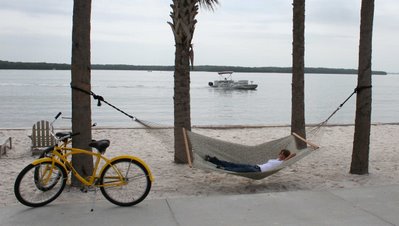
My daughter is way smarter than either of us.

Steve spent his college years in Oklahoma, watching Texas blow north and Kansas blow south. I went to school in Northern Idaho, trudging through endless freezing blizzards. Danielle, on the other hand, got a scholarship to go to the beach.

My daughter is way smarter than either of us.
Saturday, February 16, 2008
Gone Writing
As I've slipped further and further behind in my schedule, I'm off to the lake for a few days' intensive writing. See y'all next week.
Thursday, February 14, 2008
On Abandoning a Book Unfinished.
My Monday night writers group has coined a word to describe the act of abandoning a book unfinished: proctorizing. Obviously, this is something I do frequently—far more than anyone else in the group—although I’ve noticed they do it more and more these days. They’ll come in and say, “I started So-and-so’s latest, but I proctorized it after about a hundred pages,” and then go on to analyze why.
There was a time when I religiously finished every book I started, even if I wasn’t enjoying it. When I was a child, I knew I liked some books better than others, but I never analyzed why. I had this naive belief that if a book was published, then it was somehow anointed as worthy of being read.
As I grew, I came to understand the differences between popular fiction and the classics, but I still finished every book I began. At some point, one of my teachers handed out a list entitled One Hundred Novels Every Educated Person Should Have Read. I don’t know who compiled that list, but I was determined to be labeled an Educated Person. As I grimly plowed through one after the other of the books on that list, year after year, I experienced some wonderful books I probably never would have read otherwise. I also encountered some real stinkers. But when I found my attention wandering, I naturally attributed it to a failing on my part. After all, who was I to say Fitzgerald sucks?
It wasn’t until I was in college and began reading more modern popular fiction that I finally realized that yes, really awful books get published—and hit the bestseller lists—all the time. Just because some idiot editor let this tripe into print didn’t mean I had to waste my precious reading time finishing it.
Sometimes I put a book aside and go back to it later, thinking a change of mood might improve my reception of the story. At other times I can appreciate a book’s merit, but realize that for one reason or another it’s not for me. But frequently I abandon books in something close to a rage because the author has really, really annoyed me. For the sake of market research, I will at times try to continue those books for a while, hoping to understand what it is about a particular bestseller that explains its appeal. I’ve come to realize that clunky writing, silly factual errors, gaping plot holes, thin characters, predictable or implausible situations don’t seem to bother most people.
We all read for our own reasons, and find pleasure in our own combination of factors. But with so many books out there to read, and the time for reading them shrinking every day, I find myself less and less willing to tolerate a book that fails to sweep me away in that magical way I first came to love as a child. Which is why I proctorize so many books.
There was a time when I religiously finished every book I started, even if I wasn’t enjoying it. When I was a child, I knew I liked some books better than others, but I never analyzed why. I had this naive belief that if a book was published, then it was somehow anointed as worthy of being read.
As I grew, I came to understand the differences between popular fiction and the classics, but I still finished every book I began. At some point, one of my teachers handed out a list entitled One Hundred Novels Every Educated Person Should Have Read. I don’t know who compiled that list, but I was determined to be labeled an Educated Person. As I grimly plowed through one after the other of the books on that list, year after year, I experienced some wonderful books I probably never would have read otherwise. I also encountered some real stinkers. But when I found my attention wandering, I naturally attributed it to a failing on my part. After all, who was I to say Fitzgerald sucks?
It wasn’t until I was in college and began reading more modern popular fiction that I finally realized that yes, really awful books get published—and hit the bestseller lists—all the time. Just because some idiot editor let this tripe into print didn’t mean I had to waste my precious reading time finishing it.
Sometimes I put a book aside and go back to it later, thinking a change of mood might improve my reception of the story. At other times I can appreciate a book’s merit, but realize that for one reason or another it’s not for me. But frequently I abandon books in something close to a rage because the author has really, really annoyed me. For the sake of market research, I will at times try to continue those books for a while, hoping to understand what it is about a particular bestseller that explains its appeal. I’ve come to realize that clunky writing, silly factual errors, gaping plot holes, thin characters, predictable or implausible situations don’t seem to bother most people.
We all read for our own reasons, and find pleasure in our own combination of factors. But with so many books out there to read, and the time for reading them shrinking every day, I find myself less and less willing to tolerate a book that fails to sweep me away in that magical way I first came to love as a child. Which is why I proctorize so many books.
Subscribe to:
Posts (Atom)


